
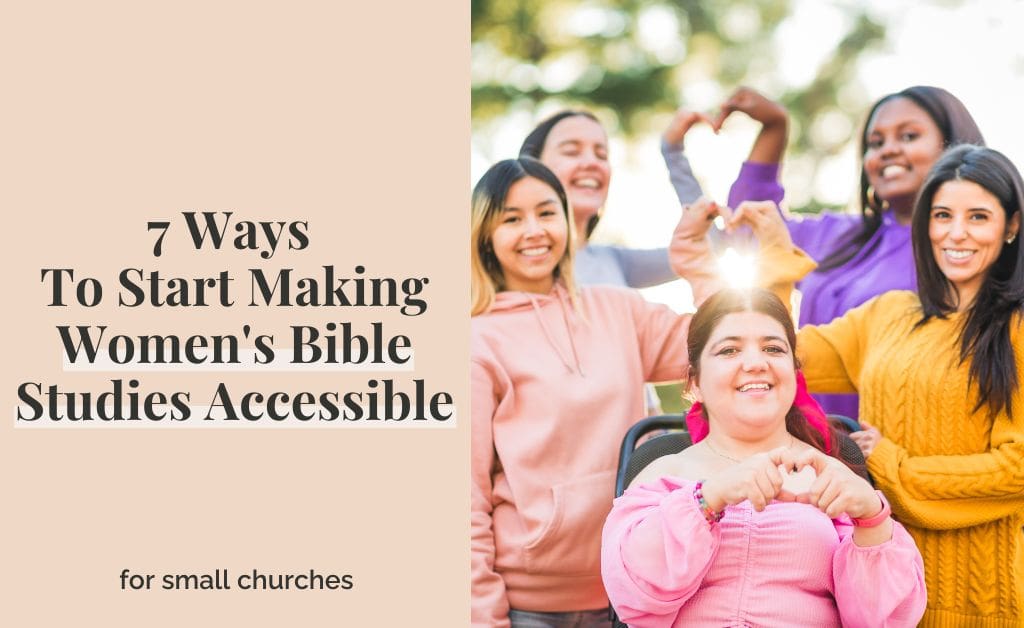
This post may contain affiliate links, which means I may earn a small commission from purchased products at no additional cost to you. See my full disclosure here.
The mandate of the Church is to share the Gospel.
Then Jesus came to them and said, “All authority in heaven and on earth has been given to me. Therefore go and make disciples of all nations, baptizing them in the name of the Father and of the Son and of the Holy Spirit, and teaching them to obey everything I have commanded you. And surely I am with you always, to the very end of the age.”
Matthew 28:18-20 NIV
Jesus instructs His disciples to go and make disciples and teach them to obey everything He had commanded them (the disciples). Small churches are uniquely positioned to share the Gospel with the world. Smaller church congregations have the luxury of knowing each other’s names and some of our personal challenges. Pastors and church leaders can be more accessible to and more easily interact with all members.
Members report feeling heard and seen in smaller congregations. Because we are smaller, we can pivot quickly to meet the needs of members and those who attend regularly. These qualities enhance our ability as small churches to share the Gospel by building relationships. Let’s consider how those qualities can help us in making women’s Bible studies accessible to all women.
Recognizing What Makes Our Bible Studies Inaccessible
First, let’s identify some barriers women have identified for joining Bible Study. Here is a list of some of those barriers:
- Time constraints for those who work outside the home
- Childcare for those with children
- Low literacy levels
- Physical Disabilities or limitations
- Neurodiversity
- Responsibility as Primary Caregiver for a family member
- Incarceration
This list of barriers doesn’t encompass everything, but it does challenge us to consider how we might work to make Bible Study accessible to all the women of our congregation and our communities. How can we build on our strengths as a small church and begin to meet the needs of women who may have found attending a Bible study group challenging? Women who face the barriers listed have different needs and concerns. Let’s look at a few ways we, as a small church, can begin to work to make Bible study accessible.
7 Ways To Start Making Women’s Bible Studies Accessible To All Women
1. Women Working Outside The Home
This first barrier is one of the most common and relatively straightforward to address. As a congregation, offer Bible study groups a variety of times and locations. Do several women work in businesses that are geographically close to one another? Consider a short lunchtime session in a central location once a week. Ask the women of your church to fill out a brief 2-3 question survey to help determine the day and time that is most convenient. Then, follow through and offer a Bible study that fits within the most commonly identified timeframe. Another option is an online group. There are several virtual meeting platforms available—research to see which platform works best for your congregation.
2. Women Who Need Childcare
Motherhood, especially Christian motherhood, is not for wimps! Both stay-at-home moms and working moms face challenges and sometimes feel like they struggle alone. As Christian women, we can come alongside and offer a wealth of wisdom, life experience, and solidarity to Moms of small children. Sometimes, this looks like providing a nursery that allows Moms to attend Bible study. For small church budgets, a paid nursery worker might not be possible. However, a little out-of-the-box thinking can yield significant dividends!
One small Church shared their innovative solution to provide childcare for women who wanted to attend Bible study. The group met in the homes of the members on a rotating basis. One woman served as hostess, one woman led the Bible Study, and one woman provided childcare for the children attending in a different room. All three roles changed with each meeting so each woman could participate in Bible study. How could your women’s ministry make Bible study accessible for women who need childcare?
3. Women With Low Literacy Levels
According to Steven Zauderer of Cross River Therapies, 54% of adults have a literacy lower than a sixth-grade level. Of those adults with a low literacy level, 34% were not born in the United States. Adults who have low literacy levels struggle in many areas of their lives. Everyday activities are difficult if you labor to read a menu at a restaurant, a contract or other legal documents, or even a newspaper.
The reasons behind a low literacy level are too expansive to explore in this article. However, chances are high that we will minister to and share life with at least one woman who struggles to read and comprehend scripture. As Christians, we are called to meet people right where they are, share the Gospel, and then disciple new believers. Bible study is necessary for believers to grow spiritually and in their walk with the Lord.
How do we minister to and make Bible study accessible to women with low literacy levels? There are some practical steps we can take. Choose a video-based Bible study that shares scripture and discussion questions verbally. Another option is to use an audio version of the Bible and play for the group the scripture you will discuss. I found this resource on ChristianBook.com that helps choose a Bible translation based on literacy levels; consider buying a variety of translations to meet the needs of women who attend Bible study.
Women who aren’t native English speakers face challenges that include social and cultural dimensions and a low literacy level. Loneliness and feeling disconnected from the world around you are real struggles for women who do not speak English fluently. Consider the eternal impact you as a Christian can have by extending friendship and including her in Bible study. Here are resources to consider as you minister to women with a heart language other than English.
- What Is Heart Language and Why Is It Significant? – Jesus Film Project
- General Resources – Literacy Resources for Adult ESOL and ABE Educators – Research Guides at Boston Public Library
4. Women With Physical Disabilities Or Limitations
Although small churches need to consider ways to minister to people with physical disabilities and limitations, realizing there are no “one-size-fits-all” approaches is essential. If your church has an aging population, there is a real possibility you already have congregants whose hearing has diminished with age. You may have individuals who struggle with diminished or loss of vision. You may have at least one congregant who uses a walker, cane, or wheelchair while attending services.
What about the mom who has multiple children under the age of two? Technically, she has no physical disability, but a ramp would surely help get that double or triple stroller from the car to the nursery. How can we help make Bible study for women with physical disabilities or limitations?
Large-print Bibles or study books are helpful for women who have lost the acuity of their sight. If a woman is blind, seek out the Bible and Bible studies in audio versions. For women losing their hearing, offer a seat close to the speaker and ensure your face and mouth are visible to them as you speak.
Turn on the closed captions if you use videos for your Bible study. One of my favorite ladies in my years of ministry was born hearing but, in her early teens, became totally deaf after an extended illness. She never learned Sign Language; instead, she read lips. She was kind and patient with me as I learned how to facilitate her participation in Bible Study.
Begin to look at the church facilities with fresh eyes! Take a chair to the parking lot and sit down. From that vantage point, evaluate entrances to the building. Once inside, repeat the exercise at every level of the building. Do you have stairs? Do you have a way for everyone to access the choir loft or altar? Can a row or two be removed and replaced with chairs if you have pews?
How can families sit together if one member is in a wheelchair? Then, go to the room where you will have the Bible study and repeat each step. Inclusion is a big undertaking, but it is very worthwhile in light of reaching women who might not otherwise have access.
- 10 Ways Your Church Can Include People with Disabilities | Faithward.org
- What I’ve learned about churches and ADA compliance | What church congregations can do to make things more accessible
5. Women With Neurodiversity
Neurodiversity has been defined as the range of differences in individual brain function and behavioral traits, regarded as part of normal variation in the human population
Respecting Neurodiversity in the Church – Disability and Faith
As the number of children and young adults with autism and other neurodiverse diagnoses rises, we as the church need to consider how we “Go, Tell, and Disciple.” Some supportive steps include clear signage that uses symbols and a sizeable quiet room that allows women to collect their thoughts or calm their emotions if they feel overstimulated. Be aware that not everyone likes to be touched. I admit this is a challenge for me. I grew up in the deep South, and we were huggers! Men shook hands, slapped each other on the back, or side-hugged. Women grabbed you in a bear hug. However, none of the behaviors may feel “safe” for everyone.
Consider adding visual elements to your Bible study to aid in processing information. But most importantly, ask, “How can I support you as you attend our group Bible study?’ These are small but important steps to help everyone feel welcome.
6. Women Who Serve As A Primary Caregiver
Being a caregiver can be all-consuming. Depending on the needs of the “patient,” the caregiver may also become confined to home. Sometimes, caregivers feel guilty for taking time for themselves. Many report feeling overwhelmed with the requirements and responsibilities associated with caring for someone at home. Often, caregivers share they feel isolated and alone. What can we do to help make Bible study accessible for women who are primary caregivers?
Start by reaffirming your love and care for them as an individual. Listen as they share their struggles. Then, ask how you can support them. One option could be to include them virtually as the group meets. A second option may be meeting one-on-one with them at a time that suits the patient’s schedule. For example, does her husband usually take a nap at 2 pm? Or does the patient go to therapy every Thursday morning? Another option may be to record the lesson and provide a written set of the scripture and questions the group studied.
Find what works, and then be persistent! Caregivers have grown used to putting their needs last; you may have to encourage her to remember she also needs spiritual food.
7. Women Who Are Incarcerated
Matthew 25:34-40, Hebrews 13:1-3
Women in prison or jail are a group of women most of us struggle to consider ministering to. Fear sometimes stops us before we even give God a chance to speak to our hearts about these women. Accessibility is a real problem for most of us. After all, they are in prison or jail, and we are not. But the Bible is clear that God loves the prisoner just as He loves the church lady.
Ministry to inmates is complex and offers its own set of challenges. However, the prison/jail ministry is a field ready to be harvested (Luke 10:2). What can we do to ensure all women have access to Bible study? Pray. Ask God what He would have you do. Your role may be to support another ministry that already ministers to inmates. Your role may be to raise money for supplies for an existing Bible study.
Honestly, He may call you to go and minister yourself- that is a distinct possibility. But Ephesians 2:10 tells us He has already gifted and equipped us for the good works He planned for us to walk in. Women who are incarcerated are daughters, mothers, sisters, aunts, and cousins. When we minister to these women, we can impact whole families for Christ. Pray and ask the Lord how to ensure Bible study is accessible for these women.
Find A Ministry You’re Equipped For
As you read this article, your heart may have resonated more with some of the groups mentioned than others. That is an entirely normal human reaction. Also, we aren’t all equipped for the same ministries (Ephesians 4:11). I pray that some of the information has challenged you to consider ways to include and serve women who may not have the same access to a church family and Bible study.
Will you stop and pray now that God will show you a group of women you can minister to as a women’s ministry and as a congregation? Then, as you move in obedience, will you share your story with me at carla@signsformysister.com? I would love to hear your “God stories” and how you are working to make Bible study accessible for all women.
Serving alongside you!
Read More:
10 Perfect Icebreakers For Your Women’s Ministry Events
9 Meaningful Tips To Strengthen Your Women’s Ministry
24 Ideas To Renew Your Women’s Ministry
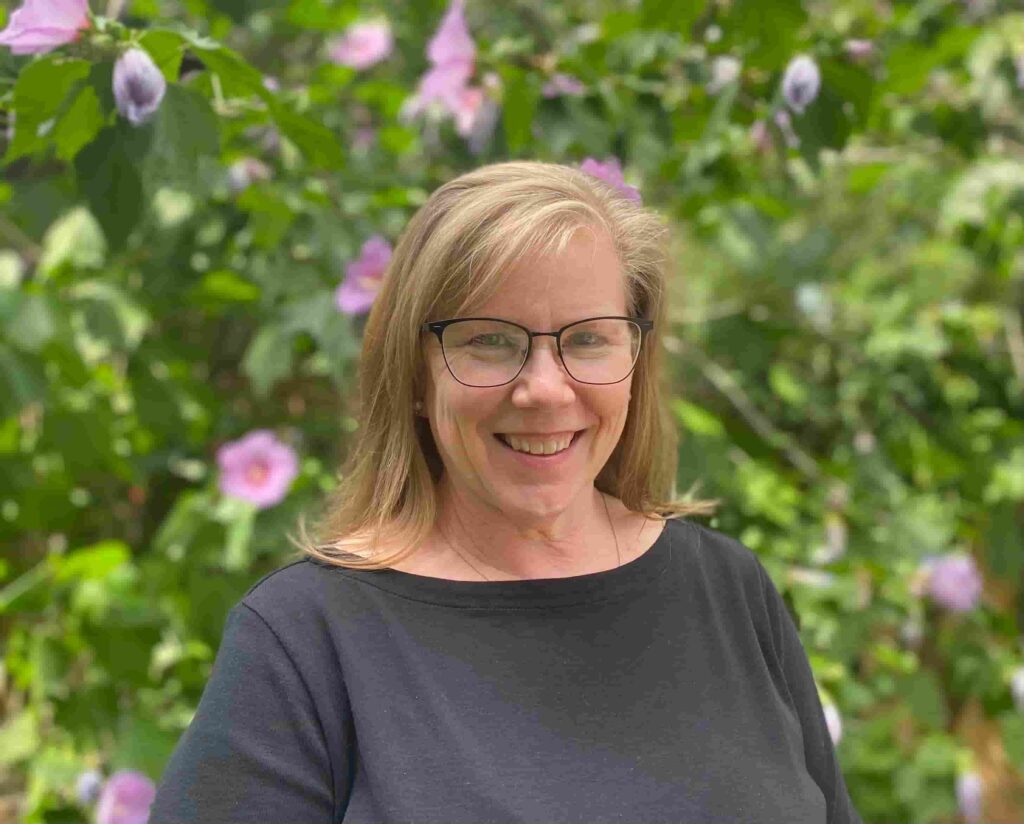
Carla Adams is a wife, a nurse, and a women’s ministry leader. As an author and a speaker, she seeks to encourage women to use their God-given tools, talents, and gifts to serve Him and others.
