

This post may contain affiliate links, which means I may earn a small commission from purchased products at no additional cost to you. See my full disclosure here.
Most of us know what it is to work hard planning an amazing event for our small tribe of students, only to have the event go awry due to poor communication or miscommunication.
Parents drop their teenager off without registering first. Medical waivers go unsigned. A volunteer doesn’t show up or shows up at the wrong venue.
Communicating effectively in the digital age is challenging for all of us as youth workers. We can’t force our students, youth leaders, or parents to finally read emails, but we can certainly do our best to bridge the communication gap by using the right tools.
So let’s talk about a few of the best apps for youth ministry communication in the hopes that you’ll be able to lead with greater clarity and a stronger connection to your people.
Why Communication Is The Backbone Of Youth Ministry
Before we jump into some communication app recommendations, I want to highlight why this is so important.
Teenagers spend, on average, more than seven hours per day on their phones. That’s not healthy, but it’s true. So one of the smartest things you can do as a ministry leader (cultural missionary, really) is to leverage that unhealthy reality for good. If students are on their phones that much, communicating with them in a safe and responsible way is totally possible.
Think of it this way. If teenagers are on their phones for almost half of their waking day, and you can find the right tools to reclaim even 10% of that time for faith-building purposes, you’re discipling without even being physically present with them.
So not only would it be wise for us to utilize apps for communication, it would also be wise for us to consider apps that encourage teenagers to grow in their faith even as they (probably) spend way too much time on screens.
But of course, we know this isn’t just a teenager’s reality. All adults spend an absurd amount of time on their devices. While that means it can be tricky to cut through the noise, it also presents an opportunity to communicate more creatively than just through email.
What Makes A Great Youth Ministry App?
Whenever you read a “Top 7” kind of list like this, your antennae probably go up–or at least they should.
There are so many different ways to quantify “best”, so it makes total sense to have a healthy skepticism around why certain apps are ranked better than others by any given person or platform. To that end, I want to sum up what I mean when I say “top” apps for youth ministry communication.
Safety
A great youth ministry communication app needs to first and foremost prioritize safety. Digital communication can be a double-edged sword, and a primary focus of all youth pastors is maintaining healthy boundaries and safety as we build relationships with our students.
The app shouldn’t feature disappearing messages, should not be primarily photo or video-based, and should include a way for a group chat to be secure from being infiltrated by strangers.
Easy To Use
A great youth ministry communication app should be easy to use. The teenagers in your youth group are digital natives, so there’s a lot they can figure out that an adult might struggle with. But since there are so many apps vying for the attention of your students, volunteers, and parents, the app should be intuitive and easy to use.
If there’s a high barrier to entry or if it’s difficult to find messages within the app, the people in your ministry just won’t use it.
Budget-Friendly
Finally, a great communication app should be budget-friendly. As a small church leader, it matters that your resources are spent in the wisest way possible.
So, for our purposes in this post, a great communication app has to be budget-friendly. The caveat to this is that if an app includes special functionality beyond communication–like volunteer scheduling, devotionals, file sharing, etc.–then it may be worth investing dollars into.
But, as always, we’ll allow you to determine what is and isn’t financially worthwhile in your ministry context.
7 Best Apps For Youth Ministry Communication (2026 Guide)
1. GroupMe
GroupMe is a simple, free group messaging app that’s great for quick communication among youth group members. A group chat within the app supports more than enough spots for a small group of teenagers, volunteers, or adults.
In fact, GroupMe chats can hold thousands of participants! Participants can use the smartphone app or even join via SMS text message, which is handy if someone doesn’t have the app installed. That makes it highly accessible.
GroupMe allows sharing of messages, photos, GIFs, and even group videos or calls. So if you ever want to have a virtual youth group gathering, volunteer training, or parent discussion group, GroupMe makes that easy!
You can create polls, @mention specific people within the group, and react to specific replies. As a free app, this communication platform is fantastic for small churches, but the app does contain ads.
As a result, you can’t be completely certain what ad content app participants could see. Still, for informal communication to students, volunteers, parents, or a combination, GroupMe is a great choice.
2. WhatsApp
WhatsApp is one of the most popular messaging apps in the world, so this blog post probably isn’t your first time hearing of it. The app uses phone-based accounts to let you create group chats. Like GroupMe, the app supports texts, photo and video sharing, voice messages, and group voice or video calls up to 32 participants at a time.
One of the cool things about WhatsApp is that it has a web/desktop counterpart, so it’s easy for your parents or volunteers to receive communications at their desk at work or at home.
The app’s key feature is that messages are encrypted for privacy, so you can be sure prayer requests or other sensitive information shared within a group can’t be seen by strangers outside of the group.
The app is free with no ads, so that’s amazing. One potential downside is that, in order to use the app, your phone number is visible to everyone else within the group.
So, in order for this to be a perfect fit for your ministry, everyone in your group must be comfortable with everyone else having their phone number.
3. Slack
Slack enters into the conversation primarily as a communication tool for your volunteer team or parents.
Created originally for the workplace, Slack organizes conversations into channels. That means you can have a dedicated space for your team or parents to chat about upcoming events, another space to celebrate discipleship wins, and still another space to talk about 80s bands, Pac-Man, bell-bottom jeans, or whatever other “old people” stuff teenagers just don’t understand!
Slack allows for direct messages as well as group channels, and the free plan allows up to 90 days of history on recently sent messages. Because notifications from the app are customizable, some volunteer members can mute notifications specifically from the 80s band channel if they were born in 2002 and think the 80s were lame!
Finally, while Slack does have a free plan, the chat history limit could pose a problem for groups that need to reference past messages year-round. But nonprofits can access a starter plan for $7-8/month, which may be doable depending on your church context.
4. Discord
If Slack is primarily suited for adults, Discord is primarily suited for teenagers. It boasts a very similar design to Slack (designated channels), but Discord was built for the gaming community, so it feels very comfortable to the next generation.
Discord calls their group chats “servers”, and these servers can function as a digital hangout space for teenagers. You can assign leadership roles within a server, meaning your adult volunteers can help you moderate and manage the space. You could even establish server leadership as a student leadership position within your youth group if you wanted!
Discord servers are secure from outside strangers because they are invite-only, and you can even configure content safety settings within your server so bad language or inappropriate links are unable to be sent. And, unlike Slack, use of Discord’s full suite of features is completely and totally free.
I will mention, however, that because Discord is such a popular app in the internet community, you may have parents in your church who have already decided the app is not a good fit for their child. Additionally, Discord does have a 13+ rating, so aligning with their policy would limit usage to mostly high school students.
5. BAND
BAND is an all-in-one group communication app that combines the best of messaging and coordination tools, which is a huge plus for youth ministries. Unlike basic chat apps, BAND provides not only group chat but also a shared calendar, announcement boards, polls, and file sharing – all within a private group space.
Think of it as a dedicated social media platform and bulletin board for your youth group. Everyone invited to the BAND group can see posts and events, RSVP to activities, and discuss in comments or chats. Band is 100% free to use, but the app does have ads.
Additionally, people without smartphones can still opt in to receive SMS alerts from BAND, so everyone can remain in the loop. BAND hasn’t been around as long as some of the other apps have, but for many youth groups, it might just be the best fit in this entire list.
6. Remind
Remind is a broadcast messaging platform originally built for schools, and it turns out to be a fantastic tool for churches as well. It allows a youth leader to send out announcements as one-way texts or in-app notifications to an entire list of students and/or parents. Recipients can’t reply-all or start a group chat on Remind (unless you enable small group conversations), which keeps the communication focused and spam-free.
Essentially, it’s like a modernized “group text” system with privacy: leaders send messages without needing everyone’s phone carriers or revealing phone numbers.
One of the neat things about Remind is that you can schedule messages to be sent out ahead of time. That allows you to batch schedule upcoming communications, which reduces your day-to-day mental load.
Remind is primarily helpful for one-way communication from the group leader to the group, but it’s entirely possible to open up two-way communication within a group.
The greatest strength of Remind is that it was created specifically for the teacher-student dynamic, so you can feel safe using this app to communicate with students. It keeps contact information private and even delivers messages via SMS for those who don’t have the app installed.
Remind is 100% free, and is a phenomenal fit for youth pastors that don’t want a digital social hub so much as a reliable way to communicate with their people.
7. Text In Church
I thought it would be great to include a communication app created specifically for the church context, and that’s where Text In Church comes into play.
Text In Church specializes in personalized two-way texting as well as email. It’s a paid service starting at $31/month (I know, a little pricey for the typical small church), but it offers a 14-day free trial so you can try it out to see if it works well for your ministry.
Text In Church integrates with common church ministry apps like Planning Center, Church Community Builder, and others, so it’s a phenomenal solution for youth groups that want their communication apps to work together for not only information communication, but also scheduling and database management.
It combines texting and emailing into one tool so you don’t have to send out a communication twice, and even boasts automated communication workflows.
In other words, if you wanted to make sure your ministry sends out a communication automatically to any student who misses youth group 3 times in a row, Text In Church can automate that for you. Pretty cool, huh? Yes, it’s paid. But also, how neat would it be to systemize ensuring nobody slips through the cracks?
How To Choose The Right App For Your Ministry
So those are seven of the best apps for youth ministry communication. If you’re having trouble deciding which app is best for you, here are some questions to ask:
- Do you want to primarily communicate effectively TO your group, or WITH your group?
- Is it of the most importance to you to increase a sense of community among your students outside of Sunday morning?
- Which group matters most to you in terms of communicating effectively? Parents, volunteers, or students?
- Do you value reducing your mental load more or increasing personalized back-and-forth engagement?
Ask these questions as you pore over the list above, and it should help you narrow down your choices! Choosing the best communication app for your ministry can be tricky, but you can do it! And since most of the options are free, remember that you can always try something out for three months and then switch platforms if it’s not working out!
A Brief Look Into Implementation & Next Steps
Once you choose the right app for your ministry, our advice is to roll it out slowly.
You may want to put together or find a short tutorial video on how it works. It may make sense to talk to a few key parents or volunteers ahead of public rollout to see if the app feels like a good fit for them. You may even want to give yourself a few weeks to play around inside the app by yourself before publicly deciding it’s the best fit.
However you choose to do it, be sure to honor your church’s policy around digital communication, and get your senior leadership on board with your choice. It may be slow-going at first, but if you find an app that’s easy to use and you’re consistent about using that app to communicate, you will get your team or group on board!
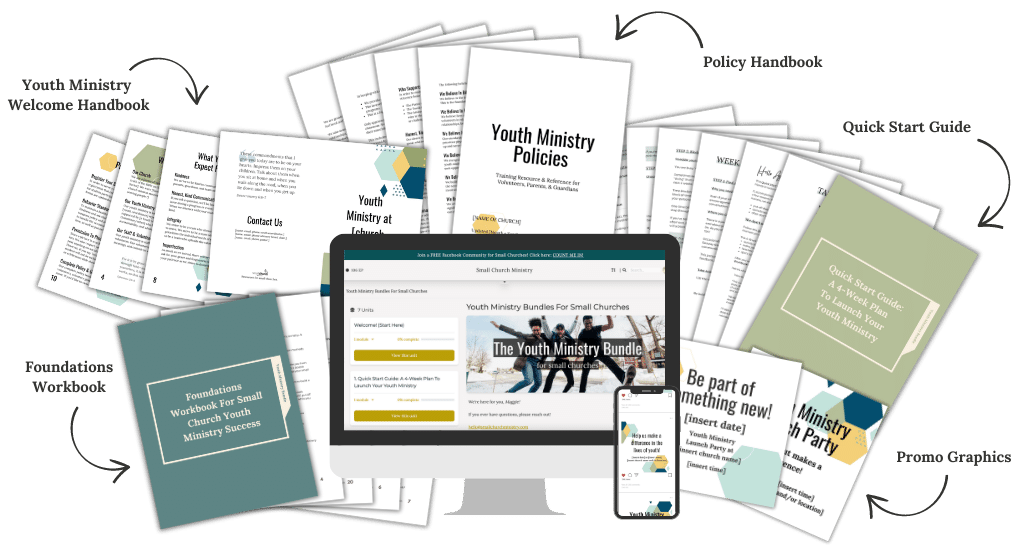
Looking for a step-by-step to starting or restarting your youth ministry?
Check out the Youth Ministry Bundle For Small Churches!
Finding the App That Fits Your Youth Group
Choosing the best apps for your group is tricky territory. There are a lot of factors to consider, and none of the options are completely and totally perfect.
But finding the right tool can make a huge difference in your stress levels as a ministry leader, the effectiveness of your communication, and even the level of community your group experiences with one another outside of Sunday mornings.
So decide which app you want to test out first, begin poking around, and take your next step to leveraging technology for Kingdom purposes!
If you are looking for a place to connect with other leaders who understand the journey, our Small Church Ministry Facebook group is a great spot for encouragement, shared wisdom, and real conversation as you lead. And when you are ready to go deeper, Everyday Influence is there to help you keep growing. It gives you live coaching, practical ministry skills, and a supportive community so you can lead with more clarity and less exhaustion.
Read More:
A Guide To The 4 Best Texting Apps For Small Churches
Affordable And Flexible Worship Apps For Small Churches
3 Best Tithing Apps And How To Use Them

Mike Haynes is the creator and owner of G Shades Youth Ministry Curriculum. Over the course of 10+ years doing youth ministry in churches of all different sizes, Mike has developed a passion for creating resources that help small church leaders thrive.
