

This post may contain affiliate links, which means I may earn a small commission from purchased products at no additional cost to you. See my full disclosure here.
Incorporating fun into your youth ministry isn’t just a good idea, it’s a necessity for a ministry that thrives. When students play together, they lower their defenses, find common ground, and build stronger connections with each other. The best youth ministry games do two things at once. They give everyone a good time, and they open the door to teach in a natural way.
This list gathers 30 indoor youth group games that work in real small-church settings. Most of them need little to no equipment, they fit tight spaces like a classroom or fellowship hall, and you can run them on the kind of budget a small church actually has. They suit pre-teen, teen, and young adult groups, and many work for intergenerational family nights too. Most also adapt on the fly, so you don’t need to know your exact headcount before students walk in.
To make this easy to use, the games are grouped by what you need from them on a given night.
- No-equipment games for when you have nothing but a room and a group.
- Team-based games for building cooperation and friendly competition.
- High-energy games for burning off steam before you teach.
- Low-key games for small spaces and for leading into discussion.
Several games include an optional “Make It Count” line. That’s a simple way to turn the fun into a short faith conversation if you want one. Skip it on the nights you just want to play.
Now, let’s get to the games!
No-Equipment Indoor Youth Group Games
These cost nothing and set up in seconds. They’re perfect for a small church where the supply closet is thin and the budget is thinner.

1. Sardines
Best for: any size group, rooms with hiding spots
Materials: none
Sardines is hide and seek in reverse. One student hides while everyone else counts and then searches. When a seeker finds the hider, they quietly squeeze into the hiding spot instead of calling it out. The game keeps going until the last seeker discovers the whole group packed into one spot like a tin of sardines.
Why it works: the slow build of stifled laughter as more bodies cram into one closet is the whole joy of it. It rewards quiet teamwork and works great when your space has nooks and corners to hide in.
2. Two Truths and a Lie
Best for: any size group, great for new or growing groups
Materials: none
Each student shares three statements about themselves, two true and one false. The rest of the group guesses which statement is the lie before the student reveals the answer. Encourage creative truths to make the lies harder to spot.
Why it works: it’s a fast icebreaker that helps a group learn surprising things about each other. Ideal when you have newcomers or are just starting up a youth group.
3. Rock, Paper, Scurry
Best for: any size group, open spaces like gyms or fellowship halls
Materials: none
This game takes absolutely no supplies except for quick thinking and fast reaction times. There are lots of versions of this game out there, but this version uses perhaps the easiest set of decisions with which most people are already acquainted. Most people are already familiar with the game Rock, Paper, Scissors. This version just supersizes it and adds an element of keep away. This is another game that includes a lot of running to burn off the excess energy! Any size group can play this one and it’s great for indoor spaces like gyms or fellowship halls.
Why it works: everyone already knows Rock, Paper, Scissors, so there’s nothing to teach. You go from zero to playing in under a minute, and the running keeps high-energy teens fully engaged.
Watch the tutorial:
4. Heads Up, Seven Up
Best for: groups of 14 or more
Materials: none (chairs or tables to rest on help)
Pick a few students to be “it.” Everyone else puts their head down and a thumb up. The chosen students quietly move around the room and press down one thumb each, then return to the front. The students whose thumbs were pressed stand and try to guess who picked them.
Why it works: it’s calm, suspenseful, and gives quieter students a low-pressure way to take part. Good for settling a room that needs to come down from a high-energy activity.
5. Categories
Best for: any size group, students sitting in a circle
Materials: none
Set a clapping rhythm and name a category like “ice cream flavors” or “books of the Bible.” Going around the circle on the beat, each person names something in that category without repeating or breaking the rhythm. Anyone who stalls or repeats is out.
Why it works: it’s quick to start and easy to theme around your lesson. Use a Bible-based category and you’ve already pointed toward your teaching for the night.
6. Ministry of Silly Walks
Best for: any size group
Materials: none
To me, nothing says fun like a bunch of classic British comedians called Monty Python’s Flying Circus. This game will have people laughing not only at each other’s silly antics, but also at themselves. This is a fantastic game to get young people to drop their guard and just enjoy the wacky fun of making a bit of a fool of yourself.
The best players in this game let it all hang out and go full-on to make their friends laugh. This is a great game to secretly record to show them after the game or just get some great pictures in the craziest positions imaginable for your youth bulletin board. Your entire group will love this one.
Why it works: it gives students full permission to be ridiculous, which breaks down walls fast. The ones who commit hardest become instant favorites, and even the shy ones end up laughing.
Watch the tutorial:
7. Honey, I Love You but I Just Can’t Smile
Best for: smaller groups, students who know each other a little
Materials: none
One student is “it” and approaches another, saying “Honey, I love you, but I just can’t smile.” The other student has to reply with the same line while keeping a completely straight face. If they smile or laugh, they become “it.” No touching allowed, just silly faces, voices, and expressions.
Why it works: it breaks the ice fast and gets everyone laughing without anyone feeling singled out for long. Simple to explain and impossible not to enjoy.
8. Wink Assassin
Best for: groups of 8 to 20, students in a circle
Materials: none (slips of paper optional)
Secretly choose one student to be the “assassin,” either by a silent tap as everyone closes their eyes or by handing out slips of paper. The assassin eliminates other players by winking at them, and an eliminated player dramatically “falls” a few seconds later. The group tries to guess who the winker is before everyone is out.
Why it works: it’s calm, sneaky, and full of dramatic fake deaths that students love. Works perfectly in a small space with everyone seated.
9. Would You Rather
Best for: any size group
Materials: a list of questions
Pose two options and have students pick a side, either moving to one side of the room or raising a hand. Mix silly questions with deeper ones to ease into real conversation.
Why it works: it gets students talking and revealing a little about themselves, and it scales naturally from a warm-up game into a full discussion starter.
Make it count: slide in a few questions with a faith angle toward the end, like “Would you rather know all the answers or trust someone who does?” and let the conversation go from there.
Team-Based Indoor Youth Group Games
These build cooperation, communication, and a little friendly rivalry. They’re ideal for a small group that needs to learn how to function as a team.

10. Underground Pass
Best for: groups of 12 or fewer, or larger groups split into teams
Materials: sheets of paper, or carpet squares for durability
This one is definitely a thinking game that will require your youth to work together to successfully complete. Your group will literally figure out the answer to the challenge one step at a time. This is a great game to teach the value of working together, to encourage leadership and problem-solving skills in your youth, and help you with team building. This game likely works best with small groups of 12 or less participants. Large groups can be broken into teams to facilitate individual engagement.
Why it works: it teaches the value of working as one unit and gives natural leaders a chance to step up while the group solves the challenge together. It’s memorable because students figure it out themselves rather than being told the answer.
Watch the tutorial:
Make it count: debrief on how the group made decisions. Who led, who listened, and what it took to move forward together.
11. Aardvark Race
Best for: any size group, a middle-school favorite
Materials: enough straws for everyone, a bag of M&M’s, a few bowls, a stopwatch or phone
If you’ve ever seen an anteater or an aardvark, you’ll quickly realize how this game got its name. Youth are tasked with transporting M&M’s from one bowl to another on the opposite side of the room using only a straw and the suction they can create. They’ll encounter lots of frustrations along the way, but those who have got greater lungs will succeed for their team. Any size group can play this game and it is a particular favorite of our middle school youth.
Why it works: it’s a simple relay that gets everyone cheering, the props cost almost nothing, and the M&M payoff at the end never hurts.
Watch the tutorial:
12. Salsa: 2 Ways
Best for: smaller groups of 15 or fewer
Materials: enough salsa ingredients for two teams, salsa-making utensils for one team, a copy of the salsa recipe, two tables, a lot of paper towels
On the surface, this game is all about having fun while making a tasty snack. But, since it’s one of our games, there is definitely a memorable twist to this one. Both teams get salsa-making ingredients but only one of the teams receives the utensils needed to make salsa from scratch. How do you dice a tomato without a knife? That’s only one of the questions you’ll be forced to answer if you’re the utensil-less team.
For this game, it’s not just about fun though, there are some excellent lessons that can be learned by playing this one! Perfect for smaller groups of 15 or less so that everyone needs to contribute to the final dish. And it does actually allow for a tasty snack at the end of the game, at least from one of the teams.
Why it works: it’s hands-on, it ends with a snack, and the uneven setup creates a built-in lesson about fairness and resourcefulness that students don’t see coming.
Watch the tutorial:
Make it count: talk about how it felt to have less than the other team, and where students see that same dynamic play out in real life.
13. Human Knot
Best for: groups of 8 to 16
Materials: none
Students stand in a tight circle, reach across, and grab two different hands from two different people. Now they’re tangled. Without letting go, the group has to work itself back into a circle by stepping over and ducking under arms.
Why it works: it forces communication and patience, and the payoff when the knot finally untangles brings the whole group together. Zero supplies required.
Make it count: use it as a picture of how the body of Christ has to work together, with every part connected, to function the way it was meant to.
14. Marshmallow and Spaghetti Tower Challenge
Best for: teams of 3 to 5
Materials: dry spaghetti, mini marshmallows or tape, a ruler
Give each team the same supplies and a set amount of time to build the tallest free-standing tower they can, topped with a marshmallow. Tallest tower that stays up on its own wins.
Why it works: it rewards planning, teamwork, and a willingness to fail and rebuild fast. Cheap, repeatable, and always a little chaotic.
15. Reverse Charades
Best for: teams of 4 or more
Materials: a list of words or phrases
Flip charades around. Instead of one person acting for the group to guess, the whole team acts out the word for a single guesser. It’s faster, louder, and far less intimidating than standard charades.
Why it works: nobody is stuck performing solo, so even shy students jump in. The group energy carries everyone along.
16. Saran Wrap Ball
Best for: any size group, students in a circle
Materials: a large ball of plastic wrap with small prizes wrapped inside, two dice
Ahead of time, wrap small prizes and candy into one giant plastic-wrap ball. Students sit in a circle. One person unwraps the ball and keeps whatever falls out while the person beside them rolls the dice trying to roll doubles. When they roll doubles, the ball passes to them.
Why it works: the race between unwrapping and rolling creates real urgency, and everyone gets a shot at the prizes.
17. Indoor Scavenger Hunt
Best for: teams of 3 to 6
Materials: a printed clue or item list, phones for photos (optional)
Send teams around your building to find items or snap photos of specific things, like “the oldest hymnal you can find” or “a team selfie with the church sign.” First team back with everything on the list wins. Tailor the list to your space and your group.
Why it works: it gets students exploring and working together, and you can theme the list around your lesson for a built-in connection point.
18. Minute to Win It Stations
Best for: any size group, rotating in small teams
Materials: common household items (cups, ping-pong balls, cookies, spoons)
Set up several 60-second challenges around the room, like stacking cups, moving a cookie from forehead to mouth using only face muscles, or bouncing a ping-pong ball into a cup. Teams rotate through and score points at each station.
Why it works: endlessly customizable, uses things you already have, and keeps everyone moving at the same time. Works great as a whole-night theme.
19. Bible Charades
Best for: teams of 4 or more
Materials: a list of Bible stories, people, or events
Play charades using Bible characters and stories. One student acts out a scene like Jonah and the whale or David and Goliath while their team guesses. No talking allowed, just acting.
Why it works: it reinforces Bible knowledge while everyone is having fun, and it’s a natural fit for a church setting that none of the secular game lists will give you.
Make it count: after a round, ask what each story teaches and why students think it still matters today.
High-Energy Indoor Games to Burn Off Steam
When students walk in wound up, give them somewhere to put that energy before you ask them to sit and listen.
20. Pan Bang
Best for: any size group, especially new or growing groups
Materials: a metal pot, a spoon to strike it with
Pan Bang is a great, simple game to play with a new group or a group that is meeting for a new youth year or a group that has new members. Not only is it fun to play and high energy, it’s a great way to teach some really valuable lessons about how your group chooses to interact and the value of each individual within the group.
In this game, everyone is in it for themselves, but the only way to “win” is to work together. Our youth groups are used to hearing the phrase “Don’t Pan Bang!” which can mean anything from “Don’t push others away!” to “Don’t take advantage of others for your benefit.” to “Make everyone feel welcome!” It’s a really great game that can be replayed over and over with any size group.
Why it works: it’s replayable with any size group, it doubles as a teaching tool about welcome and belonging, and the phrase “Don’t Pan Bang” becomes a shorthand your group carries into the rest of the year.
Watch the tutorial:
Make it count: ask what it looks like to “Pan Bang” someone in real life, and what choosing welcome looks like instead.
21. Kaos
Best for: any size group
Materials: lightweight dodgeballs, pool noodles
Lots of youth groups play dodgeball and most high-energy teens love it. Here is a variation that allows a more open style of gameplay that’s not restricted by any boundaries. As with all dodgeball-type games, the secret is in the dodgeballs. We recommend dedicated lightweight balls which help keep gameplay safe and are also very durable.
Throw in some pool noodles, which are also lightweight and don’t hurt when you get hit with them and you’ve got the makings of a memorable game that will burn off lots of energy while having a great time. It will also get your youth ready to better concentrate for the more serious portion of your activity. Any size group can play this one!
Why it works: most high-energy teens already love dodgeball, and the open format keeps everyone in the action longer. It burns off a ton of energy and leaves students ready to focus on what comes next.
Watch the tutorial:
22. The Flailman
Best for: groups of all sizes, students who love contact-style games
Materials: a Mesh laundry bag, a dodgeball, approximately five feet of rope, a “precious” object (a small stuffed animal or toy works well)
This uptempo game allows youth to channel their inner “knight” and stand against the hordes of villains trying to steal their “precious” object. You may not be familiar with it, but you’ll be equipping your knight with an ancient weapon called a flail. Of course, not a real flail because that would be incredibly dangerous.
You’ll create a safe, modern version using a dodgeball inside a mesh laundry bag tied to a short piece of rope. Your group will love this because this game is guaranteed to make memories without anyone actually being harmed in any way, except perhaps their pride. Perfect for groups of all sizes, particularly those who love contact sports with Nerf-style weapons.
Why it works: it’s active, theatrical, and memorable. The homemade flail makes it feel like an event rather than a filler game, and students talk about it long after the night is over.
Watch the tutorial:
23. Balloon Stomp
Best for: any size group
Materials: a balloon and a short piece of string per student
Tie an inflated balloon to each student’s ankle. On “go,” everyone tries to stomp and pop other players’ balloons while protecting their own. Last student with an unpopped balloon wins.
Why it works: it’s instant chaos in the best way, and balloons cost next to nothing. Great for a quick burst of energy with no prep time.
24. Crab Soccer
Best for: any size group, open floor space
Materials: a soft ball, two goals (chairs or cones work fine)
Students move only in a crab-walk position, hands and feet on the floor with their belly facing up, and try to kick a soft ball into the other team’s goal. No standing up allowed. Split into two teams and play to a set score.
Why it works: the crab-walk levels the playing field athletically and tires everyone out fast. A soft ball keeps it safe for any indoor space.
Low-Key Games for Small Spaces and Discussion
These keep the volume down, work in a cramped room, and slide naturally into a teaching moment.

25. Shaker Shakedown
Best for: any size group
Materials: a musical shaker (or something that makes noise whenever it is moved), a stool, a pool noodle, a blindfold
This one is easy to play, but hard to win. Good hearing skills and quick reflexes are essential for the blindfolded guard and quick and quiet feet and general sneakiness are required for the would-be thieves. Players try to silently approach the stool and steal the noisy item without getting hit by the guard. A pool noodle sentry weapon assures that no one gets seriously hurt while attempting their caper. Groups of any size can easily play this game without modification.
Why it works: it’s tense and quiet, which is a welcome contrast after high-energy games. The pool noodle keeps it safe, and even a small or oddly-shaped room can run this one without any adjustments.
Watch the tutorial:
26. Video of Lies
Best for: small groups, tight spaces
Materials: a way to show a video during the game and a way for someone to block out sound with a pair of headphones playing white noise or music
Here’s a low-energy fun game perfect for groups with small spaces. We’ve prepared a collection of video clips from the weirdest channels on YouTube for your teens to watch and then describe to their teammates in an effort to fool them into whether the video being described accurately reflects the video they watched. As a bonus, this is a great game to lead into a discussion on truthfulness, trustworthiness, or even the nature of evil and deception.
Why it works: it fits a small space, the weird video clips keep students genuinely curious, and it slides straight into a conversation about truth and trust without feeling forced.
Watch the tutorial:
Make it count: use it to open a talk on honesty and why truth matters inside a community.
27. Telephone Pictionary
Best for: groups of 6 to 12
Materials: paper and pens for everyone
Each student writes a phrase at the top of their paper and passes it to the next person. That person draws the phrase, folds over the words, and passes it again. The next person writes what they think the drawing shows. By the end, the original phrase has turned into something completely different and usually hilarious.
Why it works: it’s calm, creative, and the big reveal at the end is the payoff. No artistic ability required.
28. Mafia
Best for: groups of 8 to 20
Materials: none, or playing cards to assign roles
Secretly assign roles like Mafia, Detective, and Doctor. Each “night” the group closes their eyes and the Mafia silently eliminates a player. Each “day” the group debates who they think the Mafia is and votes someone out. It’s a game of bluffing, reading people, and group discussion.
Why it works: it sparks animated conversation and works in a seated circle, making it ideal for a small or narrow space.
29. Sticky Note Compliments
Best for: any size group, great as a closer
Materials: a pad of sticky notes and a pen per student
Each student writes their name at the top of a sticky note and passes it around the room. Every other student adds one encouraging word or short phrase about that person. At the end, each student gets their note back covered in affirmations from their group.
Why it works: it’s quiet, meaningful, and ends the night on a high. It also reinforces that your group is a place where people build each other up, not tear each other down.
Make it count: connect it to scripture about encouragement, like 1 Thessalonians 5:11, and talk about how words can shape the culture of a group.
30. Freeze Frame
Best for: groups of 8 or more, students in an open space
Materials: music and a way to pause it
Play music and let students move freely. When the music stops, everyone freezes in whatever position they’re in. Anyone caught moving is out. Keep going until one student is left. For a faith twist, call out a scene from a Bible story each time the music stops and have students freeze into a character from that scene.
Why it works: it’s simple, silly, works across a wide age range, and the Bible-story variation makes it feel like it belongs in a church setting, not just a school gym.
How to Choose the Right Game for Your Small Group
A big list is only useful if you can pick fast. A few things to weigh on any given night:
- Your space. A classroom calls for low-key or seated games. A gym or fellowship hall opens up the high-energy options.
- Your numbers. Some games shine with 8 students, others with 20. The list notes a best group size for each, and most adapt easily by splitting into teams.
- Your budget. Lead with the no-equipment games when funds are tight. Almost everything here uses items you already have or can pick up cheaply.
- Your goal for the night. Burning off energy before a lesson, breaking the ice with new students, or leading into a discussion each point to a different category above.
When in doubt, a no-equipment icebreaker is the safest opener, and a low-key game is the smoothest handoff into your teaching.
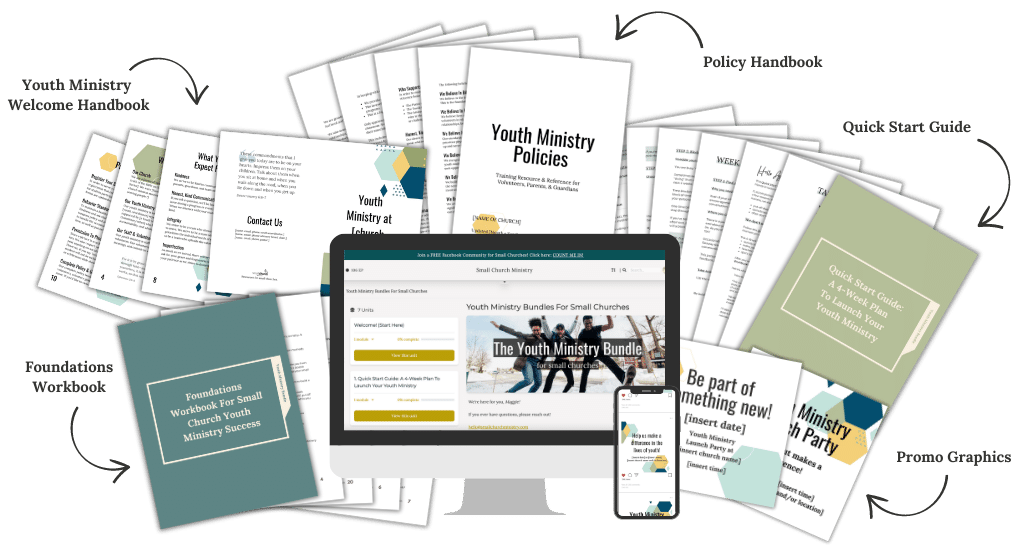
Looking for a step-by-step to starting or restarting your youth ministry?
Check out the Youth Ministry Bundle For Small Churches!
Creating A Safe Environment While Actively Learning
When playing any of these games, or any games really, make sure you’ve thought through all the potential places where things might go wrong. Do your best to make the game safe to play, but first, you’ll need to create a safe environment where young people can be themselves and find acceptance and Christian love. Then, don’t be afraid to take a little risk as long as you’ve done your best to round the sharp edges and establish good and caring habits in both your adult leaders and your young people.
Take the leap with these games because, we assure you, they were selected with you and your group in mind. All of these games have been tested by our youth so we know your group will love playing them. At ActuallyFun, we strongly believe that the most effective way to teach a lesson that will stick with your group is to practice active learning. When a person can tie a fun memory to a bigger object lesson, they will remember it longer and have a higher likelihood of incorporating it into their life.
Once you make young people feel at ease and allow them to build connections between each other, you’re on your way to tearing down those walls that all of us put up to keep others at arm’s length.
If you are looking for a place to connect with other leaders who understand the journey, our Small Church Ministry Facebook group is a great spot for encouragement, shared wisdom, and real conversation as you lead. And when you are ready to go deeper, Everyday Influence is there to help you keep growing. It gives you live coaching, practical ministry skills, and a supportive community so you can lead with more clarity and less exhaustion.
Read More:
6 Important Steps To Build A Strong Youth Ministry Team
Incorporating Mental Health Awareness Into Youth Ministry
6 Best Youth Activities That Focus On Spiritual Growth

Ed Hartman is the Chief Content Officer at ActuallyFun, a business dedicated to making it as easy as possible for youth leaders to build relationships in their group. He has worked in youth ministry for over 40 years, has trained hundreds of youth directors, and is the creative vision behind many ventures at ActuallyFun! If you want next-level youth ministry without needing to do all the work, visit www.ActuallyFun.com.

Zach Hartman is the founder of ActuallyFun, a business dedicated to making it as easy as possible for youth leaders to build relationships in their group. He has worked as a civil engineer, a full-time YouTuber, a youth director, and a business owner! If you want next-level youth ministry without needing to do all the work, visit his website www.ActuallyFun.com.
