

This post may contain affiliate links, which means I may earn a small commission from purchased products at no additional cost to you. See my full disclosure here.
Recently, I attended a Women’s Ministry Retreat as one of the speakers. I enjoyed the weekend for many reasons, including the church’s Women’s Ministry Leadership Team, which hosted the event. The ladies were welcoming, worked cohesively as a team, supported each other and the guests, and pampered me as the guest speaker. Watching the teamwork was joyful and inspiring for me as a Women’s Ministry Leader in my home church.
A healthy and functional Women’s Ministry Team can play a vital role in supporting the Ministry Leader and be a blessing to all the women served. Working as a team can increase our effectiveness and provide a richer, more nuanced experience for our congregation, visitors, and ourselves. A team can share the workload while employing many different talents and spiritual gifts to minister to the various ages, interests, and needs of the women in our congregations and communities.
We, as leaders, desire to provide meaningful experiences for women, build relationships, and opportunities to share the gospel. But trying to do all of this alone can lead to exhaustion, discouragement, and sometimes feeling like we have failed. Being a part of a team allows us to draw on each other’s strengths and gifts while meeting the many needs of those we minister to.
Are you beginning to glimpse the value of building a Women’s Ministry Team? Excellent! Let’s explore some effective ways of building a team to serve with you as you lead your congregation’s Women’s Ministry.
The Roles Of Your Women’s Ministry Team Members
First, let’s explore some of the roles team members might fill. The Ministry Team I worked with recently at the retreat is a great example. One member, gifted in leading Bible Studies, led a mini-study on women in the Bible during the afternoon break. Another member taught a beginners’ art class that helped the attendees explore God’s gift of creativity in a fun and encouraging session.
The decorations and staging of the event site were planned by a team member who had a natural talent for creating beautiful and welcoming spaces. The group’s self-proclaimed “List Maker” tracked all the supplies and kept everyone on task. Event favors, door prizes, and momentoes of the event delighted the attendees.
A team member whose love language is gift-giving delighted in choosing and purchasing all of these in the months leading up to the event. There were others who served faithfully in their giftings, even one member who declared she had no special talent! But her servant’s heart shone brightly in all she did.
As you build your ministry team, choose women with talents and gifts that are different from yours. You will benefit from team members who have strengths that complement your weaknesses. Be purposeful in adding members who have other interests or ministry focuses.
There are different kinds of gifts, but the same Spirit distributes them. There are different kinds of service, but the same Lord. There are different kinds of working, but in all of them and in everyone it is the same God at work.
Now to each one, the manifestation of the Spirit is given for the common good. To one there is given through the Spirit a message of wisdom, to another a message of knowledge by means of the same Spirit, to another faith by the same Spirit, to another gifts of healing by that one Spirit, to another miraculous powers, to another prophecy, to another distinguishing between spirits, to another speaking in different kinds of tongues, and to still another the interpretation of tongues. All these are the work of one and the same Spirit, and he distributes them to each one, just as he determines.
1 Corinthians 12:4-11
These verses are a reminder that although we each have different gifts, the gifts all came from the Holy Spirit and are valuable to the Body of Christ. Choose women who are faithful in their walk with Christ and desire to serve others using the gifts and talents God gave. Sometimes, we leaders are the first ones to recognize the potential in women who have never held a leadership role.
I encourage you to consider adding at least one woman to your team that you can mentor. Laurie at Small Church Ministry reminds us to be leaders who build legacies, not just programs. Mentoring a budding leader and helping her to develop her skills, gifts, and talents is a great way to start building that legacy.
Begin to pray and ask the Lord to reveal specific gifts, talents, and strengths that will complement your leadership. Then, as He reveals specific areas, ask Him to reveal the women He has gifted in ways that will support, supplement, and enhance- not duplicate, your gifts. Ephesians 2:10
For we are God’s handiwork, created in Christ Jesus to do good works, which God prepared in advance for us to do.
Ephesians 2:10
We are each God’s masterpiece, created with the needed gifts and talents for the good works He created us to complete. Seek out those women.
7 Ways To Start Building Your Women’s Ministry Team
1. Consult Your Church Leadership
As Christians, we all fall under the mandate of Biblical authority to honor those God has charged with serving as shepherds to your congregation. Meet with the church leadership to discuss forming a Women’s Ministry Team and seek their input. Their knowledge and insight can be valuable in identifying women who have expressed a desire to serve, or demonstrated leadership potential.
In small churches, pastors have the privilege of knowing the congregants by name and interacting with each one routinely, and their insight is valuable. As you meet with the church leadership, you may also ask about their expectations for roles, responsibilities, and reporting for the new ministry team you would like to form. Clarity on these points, in the beginning, will help you avoid many future missteps or confusion that might lead to conflict within the congregation.
2. Get In Contact With Women Individually
As you begin forming the ministry team, contact women individually and privately.
Share your vision of what the team will look like, how it will function, and what role you envision her filling. Speaking directly to potential team members will allow you to communicate how she can uniquely fill the role. The Women’s Ministry Team is not a one-size-fits-all position, and you will want to choose members rather than make a general appeal for volunteers. Privately approaching each member allows time for her to ask and answer questions and fully understand the role and responsibility she is agreeing to accept.
3. Pray As A Team
Once you have gathered your team, pray as a team and seek the Lord’s guidance. Then, work together and develop a mission statement. Franklin Covey defines an excellent mission statement as motivating people and organizations to grow. The mission statement should share what matters most to the team and your unique approach to meeting your stated goals.
One word of caution, do not become so focused on writing “the perfect” mission statement that you become stuck in the process. There is value in complete instead of perfect. I encourage you to be brief in length and use your natural vocabulary. The purpose of a mission statement is to keep the ministry team focused and growing. As you grow, you may revisit the mission statement later; it is not written in stone. The team will use the mission statement as a plumb line to evaluate decisions and choices based on how well they align with the group’s vision for purpose and ministry.
4. Begin Training
Now that you have your team assembled and a mission statement, what is next? Training!
Lifeway Research looked at the question of leadership development for ministry groups. 1 in 3 (36%) churches do not offer leadership training for new leaders. I believe this is an oversight that we need to correct. Your team will follow your leadership as they lead the ministry to the congregation’s women. Leadership is a learned skill. Leadership is an essential skill. Healthy leadership skills promote unity within the Body of Christ.
In Ephesians 4:11-13, Paul urges church leaders to equip the saints for the work of ministry. Preparation and training of team members for leadership is not an option if we desire effective and spiritually healthy outcomes. Small churches may face challenges in providing leadership training. The challenges include budgetary and staffing concerns for how to provide leadership training. Small Church Ministry has many resources ranging from free articles to reasonably priced ministry resource bundles that provide exceptional training for leaders and volunteers.
5. Grow In The Art Of Delegation
As you and the Women’s Ministry Team move forward, there is a crucial step you, as the leader, need to make. Commit to growing in the art of delegation. A healthy team dynamic includes each member working independently for the well-being and growth of the team. Even before you have formed the ministry team, reflect on your strengths and weaknesses honestly. Start asking yourself:
- What roles can you hand over to team members without any reservations?
- What roles do you find difficult to relinquish, even knowing you are not gifted in that area?
- In what areas or tasks are you feeling a nudge from the Holy Spirit to let go of your need for control?
As leaders, we often make the mistake of thinking we must have our hands on every aspect of the ministry. But the truth is that God purposely designed us to live and function in a community of believers to accomplish His purposes in this world. He gave each of us specific talents and gifts, so as we work interdependently, He gets the glory.
As the ministry team begins to work, be intentional in empowering each member to make decisions, use her gifts and talents, and help the team move forward with its goals and objectives. When we give in to the temptation and pride of micromanaging the team, we undermine their confidence and hamper the work of His kingdom.
Are you planning a retreat? Lead the team discussion about the amenities you desire in the event site, and decide as a team what is negotiable and what is not. Then, trust those you assign to research sites and bring the final 2-3 choices back to the group for discussion and a vote. Does one of the team members have the gift of teaching? Empower her to lead the newly formed Bible Study and support her as she grows in that area.
If she has never led a study group, serve as a resource to her, but do not step in to “fix” problems. Mentor her and allow her to grow in this skill set. Is there an upcoming party or shower? Delegate responsibility to the decorating committee for choosing a color theme and selecting the tablescape. Women who feel trusted and empowered will flourish in leadership roles.
6. Encourage Your Team Members
As women, we face many obstacles and challenges daily. We face issues at work, problems at home, difficulties with family members, and anxiety about our children. The list of challenges sometimes feels endless. We can be our own worst critics, ruthlessly evaluating every fault (real and imagined), and often decide we fall appallingly short of the mark. We need someone to come alongside us and encourage us. As the Ministry Leader, embrace the role of encouraging team members. Encourage team members to use their gifts in new areas or try a new skill.
Sometimes, we need someone to say, I really think you would be good at that, to give us the confidence to try. Be the first one to point out their accomplishments and wins. Brag on them to others, and make sure they overhear you! Say “thank you” publicly and often. Give credit for both team and individual accomplishments to church leadership. Write thank you notes. Send handwritten cards when you notice team members having a hard week. Ministry is hard work; serving as a volunteer ministry leader can sometimes feel overwhelming. Be a source of encouragement to those you lead.
7. Pass The Torch
A practical tip for building a Women’s Ministry Team is to mentor the next generation of leaders. Ideally, as we serve together, we identify women with leadership skills and prepare them to step into the role of ‘Women’s Ministry Leader’ in the future. Teach your skills, share your gifts, and model behaviors that will benefit future generations of women.
Biblically, we see this in the life of Paul, who intentionally mentored and taught Timothy. Priscilla and Aquila guided and taught Apollos, who became a powerful evangelist who shared the gospel and helped plant churches. Prayerfully seek out women to invite to serve on the ministry team and then teach, empower, and encourage them as they grow in their leadership skills.
Building A Women’s Ministry Team Is Worth It!
As a Women’s Ministry Leader for a small church, you have the unique opportunity to build on relationships and mentor women. Building a Ministry Team can be challenging, but the rewards are great. An effective ministry team can minister to a wider range of women by utilizing all the talents and gifts of its members. I hope you are encouraged to begin the process of forming a Women’s Ministry Team in your small church!
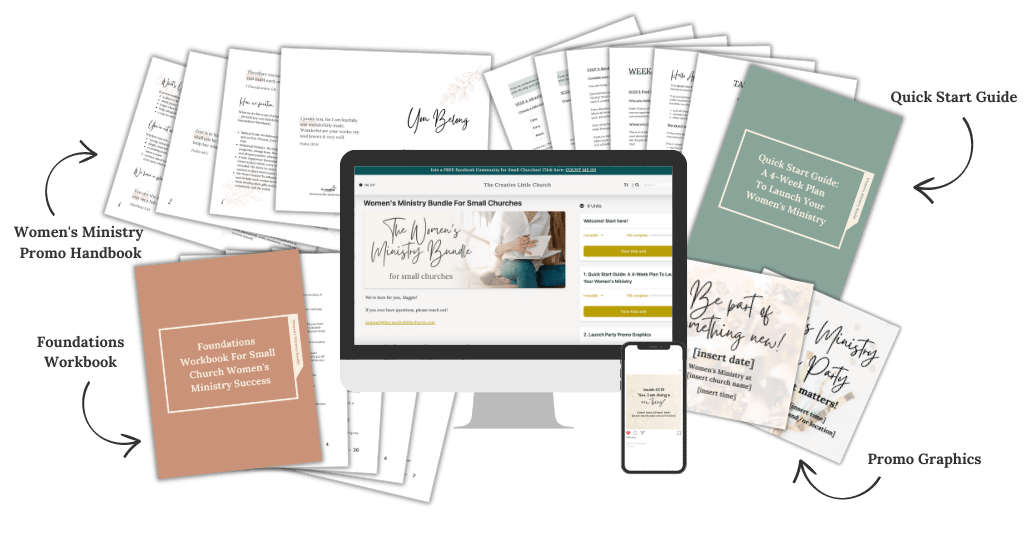
Looking for a step-by-step guide to starting or restarting your women’s ministry?
Check out the Women’s Ministry Bundle For Small Churches!
Read More:
9 Meaningful Tips To Strengthen Your Women’s Ministry
10 Perfect Icebreakers For Your Women’s Ministry Events
24 Ideas To Renew Your Women’s Ministry

Carla Adams is a wife, a nurse, and a women’s ministry leader. As an author and a speaker, she seeks to encourage women to use their God-given tools, talents, and gifts to serve Him and others.
