
This post may contain affiliate links, which means I may earn a small commission from purchased products at no additional cost to you. See my full disclosure here.
The Difference Between Inclusive & Exclusive Special Needs Ministry
There is no one-size-fits-all ministry to children with special needs. Learn about two types of ministry approaches your small church can utilize.
Three Important Facts About Ministry To Children With Special Needs
Firstly, I want to start this post by sharing 3 important facts with you about ministering to children with special needs.
- Children with communication, social, and/or emotional problems are often excluded or feel unwelcome at church. This has been verified by several studies.
- Children with special needs are being turned away from churches who do not feel equipped to serve them.
- Small churches have advantages when it comes to ministering to the special needs community,
Many Churches Fail To Include Children With Special Needs
A “Crying Baby Room” Is Not For A Child With Autism
Years ago, I worked with a child on the autism spectrum whose mother had once been devoutly Catholic. She said they had to stop going to church because they were asked to go to the “crying baby room” to watch the service on a TV due to her son’s sensitivities to light and sound. It was difficult for him to sit and remain still and quiet in the sanctuary.
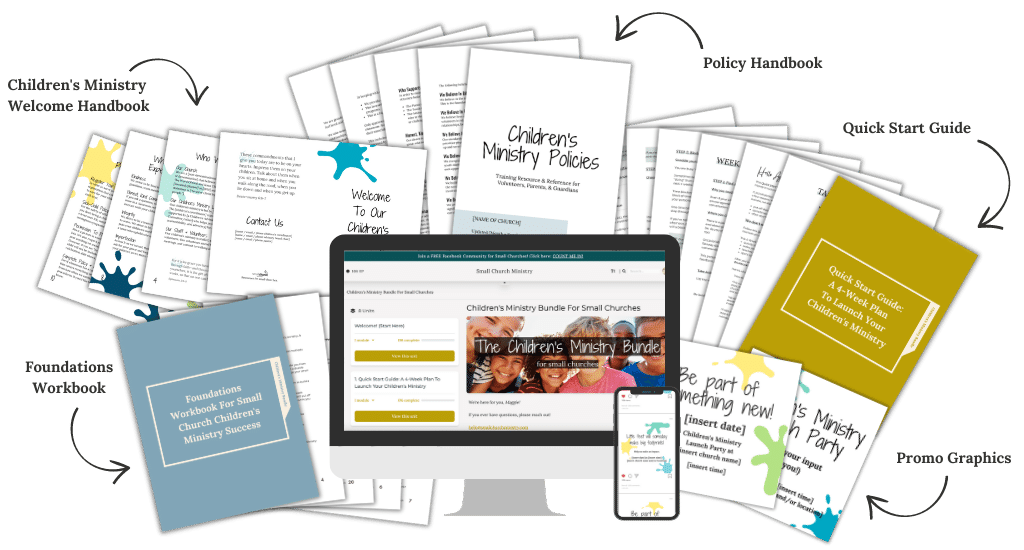
Looking for a step-by-step guide to starting or restarting your children’s ministry?
Check out the Children’s Ministry Bundle For Small Churches!
A Nursery Is Not The Place For An Older Child With Special Needs
I have spoken with several parents of special needs children who, when they picked their children up from Sunday school, realized they had been taken to the nursery to play with toys rather than remain in class and learn with the other children their age.
Parents Of Children With Special Needs Crave To Be Included, Not Excluded From Worship
Some parents I have spoken with did not see the point in going to church because they were expected to remain with their child and provide care during the service. This usually meant leaving the sanctuary to sit in a quiet room, apart from the rest of the church body.
Do You See The Pattern In These Examples?
These families might be welcome in the church building, but that was it.
Click here to read more about welcoming families: 3 Steps To Be Ready For Special Needs Visitors
Let’s talk about two approaches to special needs ministry that your small church can implement so that all people are welcome and engaged in the Body of Christ!
Type 1: Inclusive Special Needs Ministry In A Small Church
Having an inclusive ministry approach simply means that all people, regardless of ability or disability, are welcome and included in the goings on of the church. They are not separated or excluded from the Body.
Some adjustments to programs or activities might have to be made so children with special needs can be engaged and fully participate in the church community. These adjustments are often referred to in the special needs community as accommodations.
Some Simple Church Accommodations For Children With Special Needs:
- Dimming bright lights for children with visual sensitivities
- Lowering the sound volume of worship or providing noise-canceling headphones to children with sound sensitivities
- Offering snacks that adhere to a child’s special diet
- Flexible seating: Allowing a child to stand, offering extra space on a pew, or providing a seat cushion so that children can wiggle
- Providing written or picture instructions for games and lessons
- Teach lessons in different ways to accommodate different types of learners
- Breaking down verbal instructions into smaller parts and delivering them one at a time
- Providing sensory toys or activities for a child to use when they are overstimulated
These examples are just some of the ways your church can adjust the day-to-day routines to include children with special needs in church activities. These types of accommodations do not interfere with what others receive from participating in the church, and they also ensure that children with special needs can be comfortable and participate without obstacles.
Visual Picture Schedule
In my Sunday morning children’s class, we utilize a visual picture schedule every week. We have a giant one on a poster board for all the children to see, and we keep copies of smaller ones for children who benefit from holding their own schedule and referring to it often. There are pictures for each activity we do, in the order that we do them.

When we are finished with one activity, we draw the children’s attention to the schedule and show them what is coming next. This is an example of a simple accommodation that can benefit everyone and make a major difference for a child with special needs to participate in our class activities.
Noise-Cancelling Headphones
I keep two sets of noise-canceling headphones on hand for children that may be extra sensitive to noise, even if others in the church consider the noise level to be normal. You can find good quality ones on Amazon for a reasonable price.
Our elementary-age children’s ministry teachers have been very understanding about children who are sensitive to noise, and they simply turn down the volume of the music during worship time. Everyone still hears the music, and everyone can enjoy it.
Dimming The Lights
Fluorescent lights, or lights that flash or strobe, can be very uncomfortable for some children with visual sensory sensitivities, and total darkness in a room with one source of light — like a tv — can also cause discomfort.
- The elementary-age children’s ministry teachers have left lights on or lights dimmed during a movie to accommodate children with visual sensitivity.
- Covers can be bought for fluorescent light panels to filter the light and lessen the discomfort caused to children who are sensitive to light.
- I have even had a student wear sunglasses in class so they could participate without their eyes hurting!
You may find when you welcome these children into your church that you are becoming creative and more tolerant of change in order to accommodate your new members with special needs — what lovely gifts to receive from your efforts!
Type 2: Exclusive Special Needs Ministry In A Small Church
You read my examples of exclusion that children with special needs have experienced in churches. Hear me out –– “exclusive” special needs ministry is NOT talking about leaving anyone out when I bring up this next type of special needs ministry approach! I’m talking about directly serving these children and their needs.
When I talk about exclusive special needs ministry, I am referring to ministry that prioritizes the specific needs of differently-abled children.
Sometimes, there is not a community church activity available where the leaders are willing to make changes to accommodate and include children with special needs. Sometimes, a child’s diagnosis or disability requires specialized treatment and care that extends beyond basic accommodations.
My Story Of A Special Needs Vacation Bible School
When I approached my small church leaders about hosting a Vacation Bible School specifically for children with autism, it was because I knew that local churches were turning those children away from similar events. They did not know how to accommodate them, or sometimes parents of neurotypical children (children without disabilities) complained that changing the program wasn’t fair to their children.
I wanted to provide a program that was safe and perfectly suited for this population of children that are overlooked and often left out.
I wanted for them:
- a sensory-friendly worship time
- snacks that accommodated dietary needs
- lessons that were hands-on and movement-based
- crafts that engaged the sensory preferences of these children
- games that were easy to learn and provided opportunities to move around and make friends.
Basically, I wanted them to have a Vacation Bible School that was designed fully around them, not around neurotypical children with them as an afterthought.
We Invited Other Children & Youth To Join As Volunteers & Friends
I did not want to segregate these children — so I invited the children and youth of my church to join our event as volunteers and friends.
- They attended the staff training and received specific information on how to engage the children that attended the event and build relationships with them.
- They rotated through all of the activities side-by-side with the VBS attendees.
- They did everything from modeling to playing to comforting their new friends on the autism spectrum.
The result was beautiful! The children and youth volunteers were easily the MVPs of the autism VBS!
And Families Returned!
We had families who attended VBS come visit our church throughout the year, as well as join our second VBS event. These families drove for up to an hour just so their children could experience VBS where they were not only welcome but the focus of the event!
This is the type of exclusive ministry I am referring to — where children with special needs and their strengths and areas of need are the focus, and their non-disabled peers can join right in with them.
Some Simple Ways To Exclusively Minister To Children With Special Needs:
- Provide a sensory room or area for self-soothing and sensory regulation.
- Provide an alternative way for families to hear the sermon if needed/requested by the family.
- Design programs and services around children with special needs and include typical peers.
- Consider special events dedicated to supporting the special needs community.
Check out: 3 Reasons Why Your Small Church Needs A Special Needs Ministry
Combining Both Inclusive & Exclusive Special Needs Ministry
Special needs ministry doesn’t always fall into an inclusive or exclusive category.
Sometimes, depending on the needs and abilities of the children you serve, you will need elements of both approaches to fully embrace and support children with special needs and their families.
For example, at my small church …
- We have children who do well when we simply include visual or picture instructions in our games and lessons.
- We have some children who need a quiet place to calm down when they are upset.
- We have children who need a buddy to walk around with them during service.
- We have children who need to play with some Play-Doh while they sit and listen to a story so they can concentrate.
Our goal is to meet their needs in any way we can so they can meet Jesus.
The Small Church Advantage In Special Needs Ministry
You Have Exactly What It Takes!
I think often those of us who serve in small churches feel we don’t have what it takes to be effective in special needs ministry when compared to larger churches who have more money, more volunteers or staff, and can offer large special needs ministry programs. That is not the case!
According to research studies, families of children with special needs have praised small churches for the following:
- Their families were well-known by church members.
- Church members loved and cared for their children with special needs.
- The church was willing to adapt and provide programs for children with special needs.
Larger churches may have specialized staff or programs, but small churches make a difference by knowing and loving these children and their families, and just being willing to provide support.
Which Type Of Special Needs Ministry Would Work In Your Small Church?
Can you already begin to see what approach would work well in your small church special needs ministry? Inclusive? Exclusive? A mix of the two? With this purpose in mind, I encourage you to:
- Share this article with your church leadership or ministry helpers!
- Choose one way you can begin implementing a special needs ministry approach right now!
Looking for a step-by-step guide to starting or restarting your children’s ministry?
Check out the Children’s Ministry Bundle For Small Churches!
Read More
A Better Children’s Ministry In A Small Church
3 Steps To Be Ready For Special Needs Visitors In Your Small Church


This post is FANTASTIC! It explains easy, doable steps that can make a difference in a child or family’s worship experience! I love it! Thank you, Holly!
Thank you for this feedback!
This was very informative and thorough! Excellent information!
Thank you!
Thank you Chowan! We are thrilled to have Holly Sharpe on our team. She is helping us all serve better!
Hi. I am Nursery director at Solid Rock Baptist Church, Prospect, TN. My class is babies thru 1st grade. We have at least 3 kids that have special needs and want to welcome more. How can I find out about training for this ministry for me and my Children’s ministry director?
Hi JoAnn! I’m so happy you are asking! We have several people in our community who are very active in this ministry! We’ve had several speakers at our annual children’s ministry conference whom we’ve connected with. You can find out about our upcoming conference here: KidMin+Youth. If you join our Facebook Community, you’ll be able to connect with some others – especially the author of this article, Holly Brown. And Victoria White, from All Belong, is another great resource. All Belong has a special church division where the help educate and equip churches to serve diverse communities better! I hope that helps!