

This post may contain affiliate links, which means I may earn a small commission from purchased products at no additional cost to you. See my full disclosure here.
A visual schedule comes in handy on those tough teaching days! It also helps prevent distracting behavior issues. Learn how to create one this week and why it will help.
A visual schedule can help if …
- your children’s ministry class sometimes feels like a three-ring circus
- multiple children get emotional at drop off
- you sometimes struggle to manage multiple ages & personalities in your small church class
Here’s one of the best-kept secrets of a smooth-running kidmin class: visual schedules.
What is a visual schedule? It is just a list of pictures and/or words that show what is going to happen and in what order. In a children’s ministry class, it would be a list of words and/or pictures that tell what things are on the agenda for the day and in what order.
What’s so great about a visual schedule? I’m so glad you asked! Research has demonstrated that children process pictures or written words more efficiently than what they only hear, and they can more easily commit visuals to memory. What’s the takeaway for a kidmin teacher? If you want your kiddos to learn, comprehend, and remember, use visuals!
3 Reasons To Use A Visual Schedule In Your Small Church Classroom
Prevents Behavior Challenges
When children know what to expect and when to expect it, they feel more secure and less anxious. When they feel better, they behave better. If a child is looking forward to an activity and they can see when it is coming up, they are more able to wait or cooperate until it is time for that activity. If they know when a less desirable activity will be over and what they will get to do after it, they can be more motivated to participate and cooperate. Starting the day by going over the schedule together sets expectations, so the children know what to expect.
De-Escalates Behavior Challenges
What do you do if one of your kiddos is crying for mom? Show them on the visual schedule when it is time for mommies and daddies to come back. Is somebody crying for a snack? Show them when it will be snack time, and draw their attention to the fun things there will be to do until then. Is a little person demanding to play with toys, but it’s story time? Show them the schedule and explain how you will *first* finish the story, and *then* they will get to play. One of the best things about a visual schedule is you cannot argue with a piece of paper — so grown-ups don’t have to be the bad guy, or get drawn into a battle of wills — just blame it on the schedule!
Provides Needed Structure For Children And Adults
When there is no plan, it is easier for even a short time spent with children to turn into a stressful or chaotic time. Children need structure, and it also helps adults to manage their time and decrease stress. When you have a plan to go by, you can focus on the now instead of worrying about what you need to figure out next. When children can refer to a visual schedule, they learn a sense of independence and get reassurance that the class time will follow a predictable routine, which is soothing and sets the stage for good behavior.
4 Steps To Create Your Own Visual Schedule For Sunday School
So, how do I do it? You won’t believe how easy it is!
1. Decide If You Need Pictures, Words, Or Both
What age group do you teach? Can everyone read? Do you have any special needs children that would benefit from pictures or both words and pictures?
2. Make A List
Make a list with pictures/words/both of the activities you will do in class and in what order.
I like to use Microsoft Word and Google Images to make simple printable schedules, but you can also handwrite or draw your schedule, or use post-it notes (these ideas are helpful if your schedule changes a bit week to week).
3. Print, Laminate, And/Or Display
Print out larger images and glue them to a poster board so there is a giant schedule that everyone can easily see in the classroom. I have also used index cards to make mini personal schedules for some of my kiddos who need one to carry around with them. I have printed schedules on letter-size paper and laminated them, so my kids can use a dry-erase marker to mark off each activity as we finish it. This is helpful for those kids who look forward to mommy or daddy coming back to get them!
4. Review The Schedule
At the start of each class time, review the schedule and each time you change activities during the class!
This will teach the children how to use the schedule independently and help calm any anxiety or prevent/de-escalate any disruptive behaviors.
Here is an example of my kidmin class visual schedule:
🐝 Honeybee Class Schedule: Sunday Mornings
Ms. Holly, Ms. Krissy, and Ms. Abby
| 9:55 am | Drop off begins |   | |||||
| 9:55-10:20 | Play at desks |    | |||||
| 10:20-10:30 | Bathroom Break |    | |||||
| 10:30-10:45 | Prayer and Class Rules |  | |||||
| 10:45-11:00 | Worship |   | |||||
| 11:00-11:20 | Snack, Bible Story, Memory Work |   | |||||
| 11:20 | Free Play |    | |||||
| 11:30/11:45 | Dismissal | |
Create A Visual Schedule To Use This Sunday
Good luck and happy schedule-making! If you want to talk more, you can find me in the Small Church Ministry Facebook community!
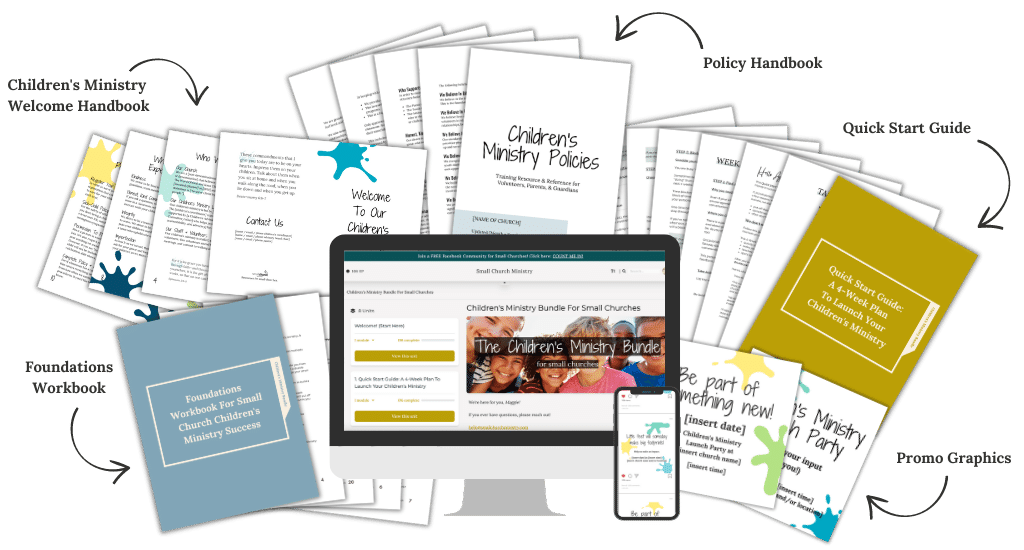
Looking for a step-by-step guide to starting or restarting your children’s ministry?
Check out the Children’s Ministry Bundle For Small Churches!
Read More
How To Engage Kids Using Worship Bags

