
This post may contain affiliate links, which means I may earn a small commission from purchased products at no additional cost to you. See my full disclosure here.
If you lead kids’ ministry in a small church, I’d bet you’ve wondered whether you should just write your own Sunday school curriculum. Nothing out there seems made for a room like yours, with a four-year-old and a ten-year-old sitting side by side and a different set of kids showing up week to week. So building your own starts to feel like the answer.
Here’s my honest take before you start from scratch. Most small churches don’t actually need a homemade curriculum, and writing one can quietly cost you the very thing you’re trying to give your kids, which is you. I say that as someone who’s done it, loved every minute, and learned the hard way.
The Pull To Build Your Own Is Real
Let me start with what’s good about it, because there’s a lot. A curriculum you build yourself can fit your church exactly. Your kids, your space, your season, all of it. No boxed program off a shelf is ever going to know your room the way you do.
And I understand why the pull is so strong. Most curriculum on the market is built for bigger churches with consistent numbers and enough kids to fill a class of one age group. When that’s not your reality, adapting it down can feel like a constant fight. You’re handed lessons that assume a full room and a plan that assumes the same kids come every single week. That’s not your Sunday. So of course writing your own sounds appealing. You want something that finally fits.
For the right teacher, it’s also a real joy. Some of your volunteers come alive when they get to dig into Scripture and pull together the pieces they love. I’ve been that teacher. When you’ve got a team like that, writing something together isn’t a burden at all. It’s some of the best work you’ll do all year.
So if you feel the pull, you’re not wrong to feel it. I want to be clear about that. The trouble with writing your own usually isn’t that it turns out worse than what you could buy. A lot of times it turns out better. The trouble is what it costs you to get there, and where that cost lands.
What I Learned The One Time I Tried It
I did this once, and we had so much fun. I gathered a team, and there were five or six of us adults digging into the truth of Scripture and getting genuinely excited about it. We built teaching centers. We had one for music and one for science. We even had a kitchen one and a drama one. We wrote the whole thing ourselves, and honestly, we had a blast doing it.
Then the pastor I was working for pulled me aside and said, let’s talk about this. He asked me how much time I was pouring into building something that was a little better than what I could already find, when what I could find was probably good enough. He asked me to look honestly at where my hours were going.
And here’s what I had to admit. I was spending so much time preparing lessons that I wasn’t spending as much time as I could with people. The curriculum was beautiful. But it was eating up the very hours that were supposed to go to the kids.
That’s the cost that’s so easy to miss. Writing your own isn’t just more work. It’s a certain kind of work, the kind that keeps you at your desk and away from the children you’re doing all of this for. There may be a little person in your ministry who needs your presence a whole lot more than they need your creative writing skills.
So, Should You Write Your Own Sunday School Curriculum?
Write your own Sunday school curriculum only if your teachers have the time and confidence to keep it going, and only if building it won’t pull you away from actually being present with your kids week to week.
Two questions have helped me here more than any list of pros and cons ever did. Sit with both of these honestly before you decide.
Can Your Teachers Actually Carry It?
Building your own material and keeping it going asks a lot of a volunteer. Some teachers thrive on that. A lot of them don’t. Many of your teachers won’t feel confident writing lessons from scratch, and when they don’t feel capable, they simply won’t do it. I believe they can. But if they don’t believe it, you can’t force it.
So look honestly at who you actually have, not who you wish you had. If building your own means one tired volunteer staring at a blank page every Saturday night, you haven’t helped your teacher. You’ve handed them one more thing to dread. A curriculum only serves your church if the person teaching it can keep going with it.
Is That Time Better Spent With Your Kids?
This is the question my pastor was really asking me. If the hours you’d pour into writing your own would otherwise go to knowing your kids, showing up for them, and loving them well, then the trade might not be worth it, no matter how good the finished lessons turn out.
I’m not saying good lessons don’t matter. They absolutely do. But the point was never to produce a curriculum. The point is to share Jesus with the kids in your room. If your building project is quietly stealing you away from them, that is worth stopping for.
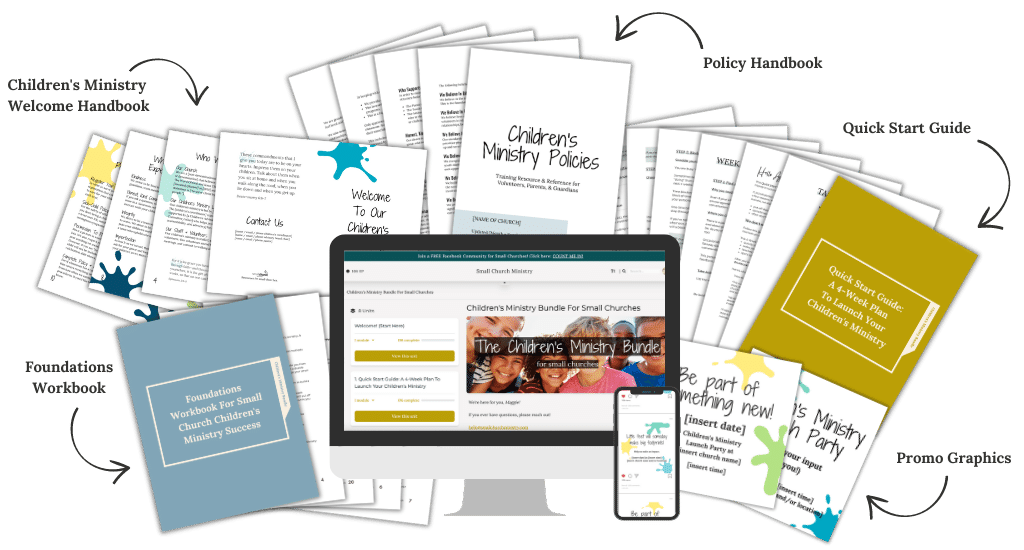
Looking for a step-by-step guide to starting or restarting your children’s ministry?
Check out the Children’s Ministry Bundle For Small Churches!
You Probably Need Less Than You Think
Here’s the part that took the pressure off me, and I hope it does the same for you. Most small churches don’t need a curriculum built from nothing. Adapting something that already exists will get you most of the way there for a fraction of the time.
You can start with an inexpensive base and build simple lessons around it. You can take a solid boxed curriculum and adjust it to fit your room. If you love pulling from different places, you can shape lessons from the good resources already out there. Any of those gets you most of the benefit of writing your own, without the cost that pulled me away from my kids.
And remember, there isn’t one right curriculum, and there never was. What’s right depends on your teachers, your kids, and your season, and in a small church all three of those can change from one year to the next.
If you want somewhere to start, we walk through the whole decision in our guide to choosing a curriculum for children’s Sunday school, and if you want a simple, low cost place to begin, we lay one out in a cheap and easy children’s ministry curriculum option.
Keep Your Eyes On The Real Goal
So, should you write your own Sunday school curriculum? Maybe. If it would light up your team and it wouldn’t pull you away from your kids, it might be a really good thing for your church. If it would bury you in lesson prep and keep you glued to your desk, it’s okay to let it go and give that time back to the kids instead.
Just keep the real goal in front of you. The curriculum is there to serve your teacher, not the other way around, and it matters a whole lot less than your own walk with Jesus and the time you actually spend with your kids. We teach out of what God is doing in us, so protect that first.
You are not failing your kids by choosing not to build your own. In a small church, sometimes the most faithful thing you can do is pick something that’s good enough, and hand the hours you saved to the people who are right there in front of you.
If you are looking for a place to connect with other leaders who understand the journey, our Small Church Ministry Facebook group is a great spot for encouragement, shared wisdom, and real conversation as you lead. And when you are ready to go deeper, Everyday Influence is there to help you keep growing. It gives you live coaching, practical ministry skills, and a supportive community so you can lead with more clarity and less exhaustion.
Looking for a Sunday school curriculum built for small churches?
We recommend Two or More™—a low-prep, Bible-rich curriculum created specifically for small churches. It works with mixed-age groups, flexes to fit whoever shows up, and makes it simple for volunteers to lead. Learn why we love it here.

Already using it? Check out our Two or More™ video guide for practical tips to get the most out of every lesson.
Read More:
How To Become A Stable Church For Young Families
How To Run An Effective Children’s Ministry With Only A Few Kids
Youth Pastor Interview Questions: What To Ask Before You Hire

