

This post may contain affiliate links, which means I may earn a small commission from purchased products at no additional cost to you. See my full disclosure here.
Looking for ways to support moms around your small church? Take a look at these 8 steps to starting a community-based moms support group.
Parenting can be the best and the hardest thing you ever do. Many people struggle for years and only receive help when things go badly, like behavioral issues at school or DHS having to step in. Having a tribe –– a system set up for support and encouragement –– is essential, yet so many are missing it. How do we, as the small church with limited resources, step in to help?
1. Open A Moms Group For Your Community
One way to provide needed support is to offer a moms group that is open to the community that meets weekly. You may not have many moms in your church, but your community is surely packed with them. Many of whom desperately need the light of Jesus shined into their lives in a hands-on way.
2. Choose Which Moms You’ll Reach
You cannot realistically reach everybody, and the ministry will be more effective if you are aiming at meeting a specific need. Are you passionate about pregnant women, moms of littles, or moms parenting teens? What people-group has God laid on your heart?
3. Build A Leadership Team Or Find A Partner
Draw people in who want to help and are also passionate about the same people-group. I wanted to make sure that older women could pour into the moms I was focusing on, so our group had peer leaders and mentor leaders.
- Peer Leaders: Women who are in the age and stage of the group they are leading.
- Mentor Leaders: Women who have aged out of that particular stage but have the wisdom to share and a heart for pouring into others.
4. Develop The Foundation: Vision, Mission, & Goals
Start by covering everything with prayer. Let God build this ministry from the ground up. Come up with a vision statement, mission statement, goals, and maybe even a logo, so there is a brand for people to share and connect with.
- Vision statement: Everything should aim back to this. The lofty goal.
- Mission statement: The nitty-gritty of how you will achieve the vision.
- Goals for the next few months as the ministry is getting on its feet and for future growth.
5. Decide On Your Structure: Meeting Schedule & Group Guidelines
Are you going to be teaching a Bible study, offering parenting classes, or walking through a set curriculum? Better Together: Because You’re Not Meant to Mom Alone by Jill Savage is a great starting point. You could also consider modeling after a successful support group ministry, like Embrace Grace, for women facing an unexpected pregnancy, or Celebrate Recovery, a Christian 12-step program for anyone who struggles with hurt, pain, or addiction of any kind.
Meeting Schedule
The basic support group model is …
- Fellowship
- Teaching
- Open-share
What Is Open-Share
Open-share is going around the room and letting everyone share what is on their hearts or what has happened in their week. I suggest using roses (1 good thing that happened) and thorns (1 bad thing that happened) to structure this time. This forces the person to think about both the good and bad in their week, so it isn’t sugar-coated and doesn’t turn into a complaint time.
“I’m_________ and I am seeking advice. ” Or “I’m __________ and I’m just sharing. My rose for this week is________. My thorn for this week is_________.”
Guidelines To Protect Your Moms Group
Having agreed-upon rules or guidelines protects everyone involved and helps people feel secure enough to open up and be real. Below are the guidelines I use for my group.
- Keep your sharing focused on your own thoughts, feelings, and actions.
- Do not wander to other people’s problems or non-group related topics. Use “I feel” language: I felt __________ when __________ because __________.
- There is no crosstalk please. (Crosstalk is when two people engage in a dialogue during the meeting, excluding all others. Each person should feel free to speak during the discussion time and open-share time without fear of interruptions.)
- We are here to support one another. We will not attempt to “fix” one another.
- No mom shaming or judging. The exception is when someone specifies “I’m seeking advice” during their open-share time. If there isn’t enough time to offer advice during open-share, please seek that person out afterwards.
- Anonymity and confidentiality are basic requirements. What is shared in the group stays in the group. The only exception is when someone threatens to injure themselves or others.
- We do not share information with our spouse or best friend. This includes not discussing what is shared in the group among other group members. This is called gossip.
- Offensive language has no place in a Christ-centered support group, including no graphic descriptions. Please watch your language, including using the Lord’s name inappropriately. If anyone feels uncomfortable or triggered by another’s graphic description, they may indicate so by raising their hand during open-share time.
6. Promote To Your Community
How are you going to let the community outside of your small church know that this new ministry has started? Putting up flyers in local businesses is always great, but there are so many other ways to get the word out.
- Start a Facebook group, page, or website. This allows anyone who finds out about your group to get more information easily. Most people would rather check a group out online anyway before they show up in person. Make sure to link the group back to your church’s Facebook page or website as well.
- Contact Public Health to advertise your group in the parenting classes they already offer.
- Personally talk to and then email a flyer to the school principals and counselors in your area. Especially if you have a local school district, it is important to build relationships with the people that could send moms your way who need support.
- Hand out postcards at parades, fairs, or community activities where moms might be.
7. Just Do It!
Jump in and get started. Small is not bad, it is simply a starting point. If you have to pivot as you go, just remember that all-important “F” word … flexible! It is okay if things have to change as you go. No first-time ministry runs perfectly smooth the first time around.
8. Vision For The Future
Always keep an eye out for growth. How are you going to grow your ministry? Who could be invited in to help financially, spiritually, or physically, like making cookies or offering childcare? Who is attending that could be a leader in the future? How is God leading your ministry to change in the future to better reach people?
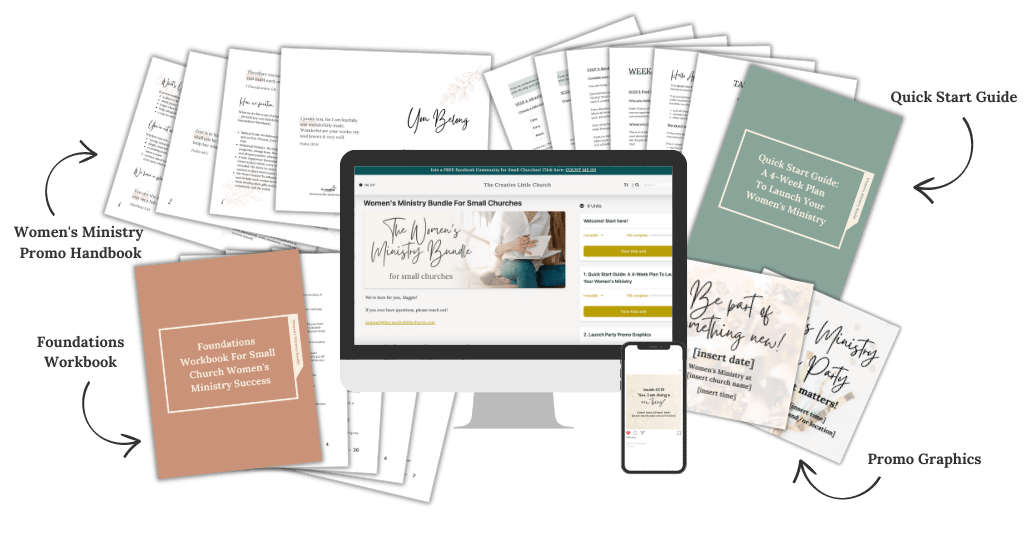
Looking for a step-by-step guide to starting or restarting your women’s ministry?
Check out the Women’s Ministry Bundle For Small Churches!
Read More


Thank you for sharing
Are there grants available to start a MOPS group at our small church?
I’m not sure. Have you reached out to MOPS or other organizations in your community? (we do not give grants – i’m not sure if thats what you are asking)
I found this very helpful, Thank you and God bless 🙂
Sweet! Thanks for letting us know! ❤️