
This post may contain affiliate links, which means I may earn a small commission from purchased products at no additional cost to you. See my full disclosure here.
Oftentimes, we know how to create “fun” in children’s ministry, but have you wondered how to create a safe environment in children’s ministry? Here are 7 key areas to consider and best practices to help create a safe & fun environment for your church’s children’s programs.
- Environment
- Volunteers
- Supervision
- Registration & Consent
- Illness/Allergies/Medication
- Photos/ Social Media/ Online Safety
- Off-Site Events
Whether you already have a policy book or you need an update, use this as a checklist for conversation and decision-making with your team or board.
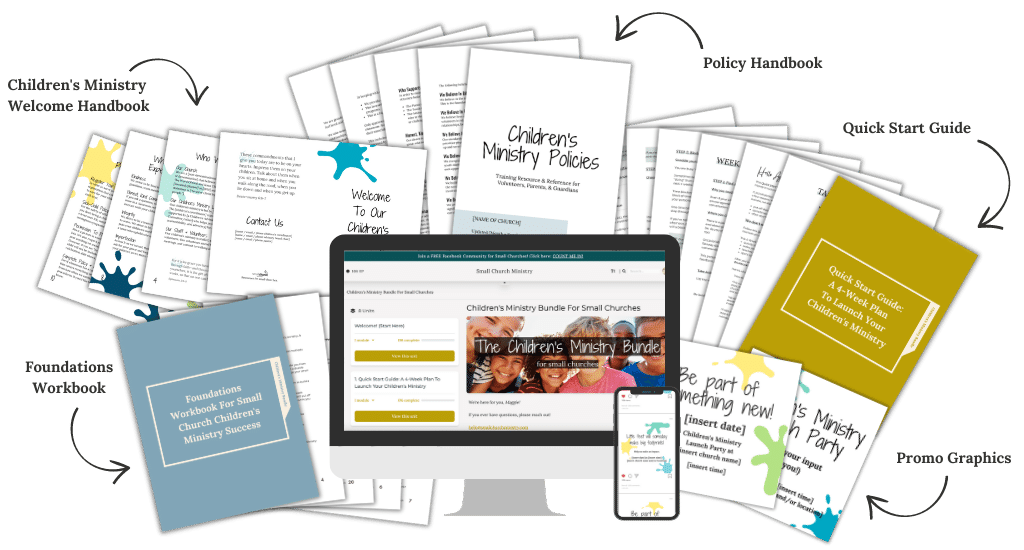
Looking for a step-by-step guide to starting or restarting your children’s ministry?
Check out the Children’s Ministry Bundle For Small Churches!
A Safe Environment In Children’s Ministry
What does your space look like?
Best practice: Have a large space with doors, windows, and close proximity to the bathroom.
Think about:
Access doors
- How do people come in and out?
- In order to create a safe place, consider how someone could enter your space.
- Are there doors that need to be monitored?
- Can children run out of the room without anyone noticing?
- How far away is the washroom? Or the kitchen?
- Will children have to pass by other adults on their way to use the washroom?
Adult: Child Ratios
Do you have a printed policy for volunteers?
Best practice: Have 2 unrelated adults in a classroom for every 7-10 kids.
Think about:
- Are there classes you can combine in order to have 2 teachers?
- Is there youth you can develop to lead?
Supervision
Does your policy include activities & age group requirements?
Best practice: Always have adequate supervision. In order to create a safe environment, we need to make sure our highest priority is supervision.
Think about: Activities with a higher risk require more supervision, which means we should increase leaders.
- Games
- Outdoor Activities
- Bathroom Trips
Nursery
Best practice: Parents change their own child’s diaper.
Think about: Consider asking an usher to grab the parents or have a system to inform parents.
Obtaining a cell phone number in case a baby/toddler needs their parent is the easiest. This can be kept in a binder or written on the child’s name tag. Let parents know you will be texting them if needed during the service.
Preschool Children (Ages 3-5, should be potty-trained)
Best practice: A class trip to the washroom. Never go into the washroom stall with a child. If needed, prop the outside door open, and assist as needed with the cubicle door open enough for the child to maintain privacy.
Elementary Children (Grades 1-5/6)
Best practice: Buddy system –– send them with another child from the class. Buddy systems help establish a safe environment.
Registration & Consent
Are you keeping good records?
Best practice: Attendance should be taken at each and every activity and kept as records.
Think about:
- Creating a registration form to be completed each year for every child (youth). This helps to ensure you have updated information, such as an address, date of birth, and any medical conditions, as well as communication (mail, email, or social media) and photo consent.
- For each off-site activity, it is best practice for parents of anyone under 18 to complete an informed letter of consent. This highlights the added risk of the activity, such as traveling together in a vehicle, drowning, or risk of injury.
Illness/Allergies/Medication
Are you aware of special medical needs?
Best practice: Obtain any information about allergies or medication before you permit anyone to participate in your ministry programs, especially if you are serving snacks!
Think about:
- Posting a sign on the door that says “we serve snacks in this class” and training your leaders to ask any “new” parents about allergies.
- If you do have children with allergies, make sure to post a list in a noticeable place (e.g., where they would be prepping or handing out snacks).
- It is best practice not to give any child any medications. (However, there are some programs where certain medications need to be administered.)
- Epi-pen: Parents should inform the leader, and the child should carry it and be trained on how to administer it. A conversation with parents on expectations is needed, and with the ministry leader(s), they can make a plan of action.
- Asthma inhalers: the child should be trained on how to administer their medication and should keep it on them at all times. Again, a conversation with parents should be scheduled to craft a safety plan together.
Illness
Best practice: Deny participation to a sick child. You can display your ministry’s expectations as a sign so that parents are not caught unaware. You can also include it as part of your registration form.
What symptoms are we talking about? Symptoms of a cold or flu such as runny nose, fever, sneezing, coughing, vomiting, diarrhea, or pink eye.
Best practice: If you find out afterward about a situation where a contagious disease was discovered, such as hand, foot, mouth disease, pink eye, or measles, you must have a way to contact all parents to inform them. This is why attendance records, as well as registration forms are best kept on hand.
Photos/Social Media/Online Safety
Are you diligent with media permissions?
Keeping A Safe Environment With Photos
Best practice: Request permission before taking someone’s photo, especially a minor.
- This can be asked on a registration form or separately at the beginning/ registration process of an event. It is always best you obtain photo consent for each event you are taking photos at.
- There are different purposes for taking the photo, so make sure you are clear about your intentions for the photo. Offer different levels of opt-in for parents.
- Internal Photos: Used only for program or church purposes.
- Externally: Could be used on the website, promotional materials, distributed to others (VBS group photos), or on social media.
Social Media
Social media is a great opportunity to let people know about your church and events; however, when posting (on the church’s page), make sure you have gained consent from every person who shows up in a photo.
Best practices for a safe environment on social media:
- Never tag anyone in a photo –– they can do so if they would like.
- Never use anyone’s name in a caption.
- If you are going to add photos of children playing a game or creating a craft, taking a photo from behind or above is best! That way, you don’t have anyone’s face directly in your picture.
Online Safety
Best practice: Never communicate with a minor through social media or direct messenger one-on-one. It is always best to communicate with parents first!
- If you are hosting an online event, make sure there are at least 2+ participants and you before you turn on your video. Also, if you can, record the meeting and store it permanently.
Off-Site Events
Have you put thought into special circumstances?
Best practices for planning a trip with minors while keeping a safe environment:
- Make sure to gain consent from parents for all activities.
- Make sure you have adequate supervision: 2 adult female leaders and 2 adult male leaders minimum! If it is a gender-specific event (e.g. boys camp), bring a 3rd or 4th leader –– they could be jr. leaders as well. (For more on jr. leaders, read: How To Train Junior Teachers: A Solution For Mixed-Aged Classrooms.)
- Adults are to share sleeping accommodations, separate from the children. Jr. leaders and adult leaders should not share as they are still minors.
- With shared bathrooms, adults are not to shower at the same time as children.
- An adult should never be alone with a child (out of the view of others).
- Make sure parents have an emergency contact number for the main leader.
- Make sure you have asked about medications and are aware of medications that need to be administered.
Safety & Fun Need To Go Hand-In-Hand For A Successful Children’s Ministry
These are my recommendations for creating a safe and fun ministry. These 7 areas should never limit your ability to run a children’s ministry program. They should enhance it and allow you to create a safe and caring atmosphere where both kids and leaders can have fun, learn, and grow together!
If you’ve lost your joy in serving in children’s or youth ministry, read this: 4 Mistakes Holding You Back From More Joy In Small Church Ministry.
Check out this product for purchase if you want more on children’s ministry foundations, customizable handbook, policy handbook template, and more … Children’s Ministry Bundle
Looking for a step-by-step guide to starting or restarting your children’s ministry?
Check out the Children’s Ministry Bundle For Small Churches!
Read More
Keeping Kids Safe In Church Youth Group
3 Reasons Why Your Small Church Needs A Special Needs Ministry

